온라인강의
강사명Suchan Chang
강의시간24분
강의개설일2025-12-10
강의소개
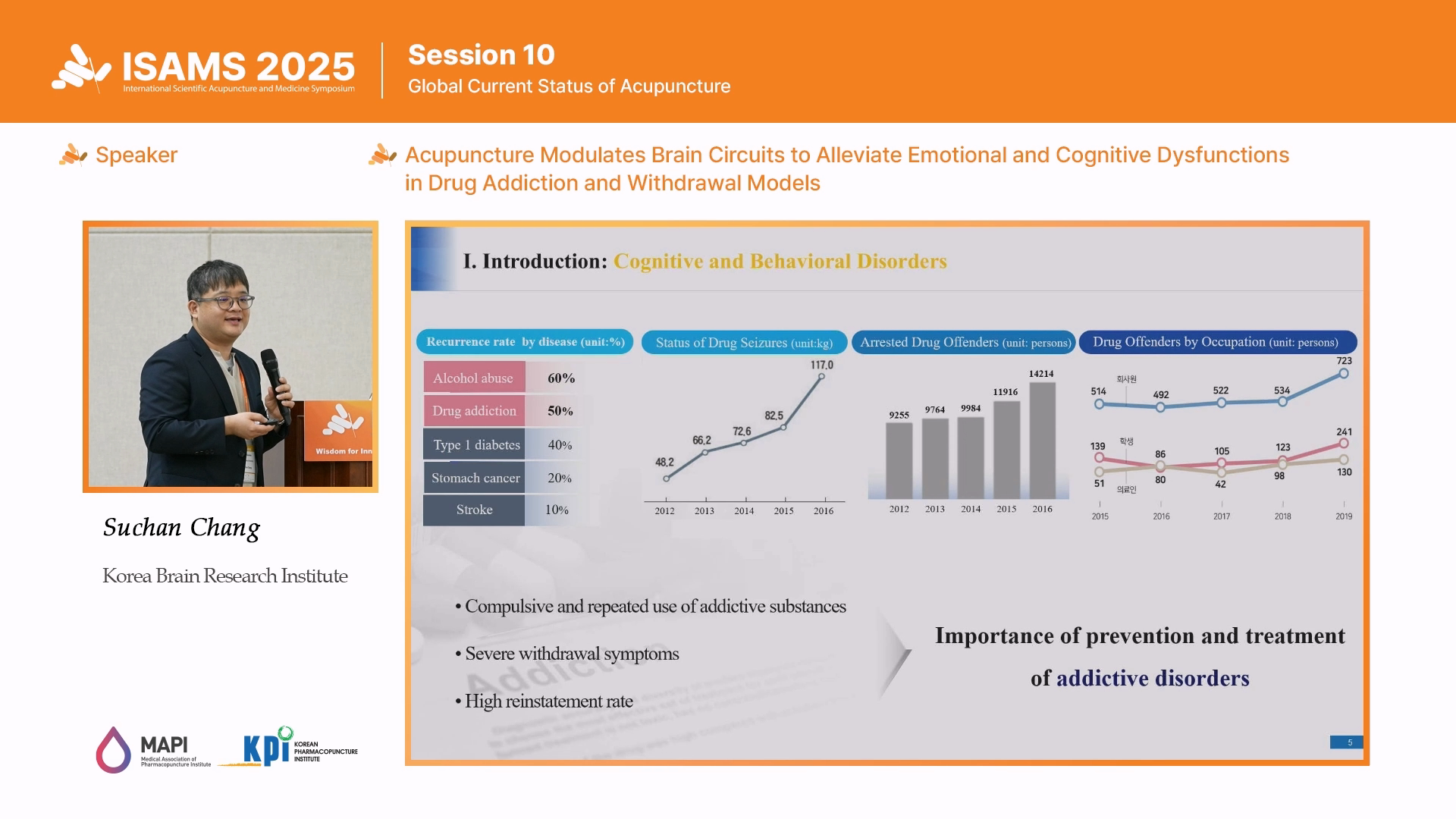
Objectives: Drug addiction and withdrawal are associated with maladaptive changes in brain reward and inhibitory
circuits, leading to emotional and cognitive impairments. This study aimed to investigate whether acupuncture at
Shenmen (HT7) points modulates specific neural circuits to attenuate alcohol- and cocaine-related behaviors, and to
identify the underlying neurobiological mechanisms.
Methods: Using alcohol-dependent and cocaine-treated animal models, we examined the behavioral and
neurochemical effects of HT7 acupuncture. Behavioral analysis included alcohol withdrawal tremor, anxiety
like behaviors, alcohol self-administration, and cocaine-induced locomotor activity. Neurophysiological and
neurochemical changes were assessed by β-endorphin measurements in the nucleus accumbens (NAc), in vivo
extracellular recordings, dopamine release monitoring, and optogenetic or lesion-based manipulation of specific brain
regions, including the arcuate nucleus (ARC), rostromedial tegmental nucleus (RMTg), lateral habenula (LHb), and
medial prefrontal cortex (mPFC).
Results: HT7 acupuncture in alcohol -dependent rats attenuated withdrawal tremor, anxiety-like behaviors, and
alcohol self-administration, while restoring β-endorphin levels in the NAc and reactivating ARC β-endorphin neurons.
In cocaine models, HT7 acupuncture reduced cocaine-induced locomotor activity and NAc dopamine release
via activation of RMTg GABAergic neurons, effects that were abolished by RMTg silencing or LHb–RMTg pathway
lesions. Additionally, acupuncture increased mPFC neuronal firing and engaged glutamatergic projections to the LHb,
suppressing cocaine-induced behaviors and dopamine release; these effects were blocked by mPFC lesions or mPFC
LHb pathway inhibition.
Conclusion: Acupuncture at HT7 modulates multiple brain circuits—ARC–NAc β-endorphinergic projections, LHb
RMTg GABAergic pathways, and mPFC–LHb glutamatergic connections—to suppress drug- and alcohol-related
behaviors. These findings suggest that acupuncture may serve as a novel therapeutic strategy for substance use
disorders by restoring inhibitory control over mesolimbic reward systems, thereby alleviating emotional and cognitive
dysfunctions associated with addiction and withdrawal.
강사소개
My area of research involves investigating the neurobiological mechanisms of
drug addiction and acupuncture treatment. Currently, the two main topics of my research focus
on the role of reward and aversive circuit in drug addiction (ex. mesolimbic dopamine system) and neurobiological
ascending pathways of acupuncture stimulation.