온라인강의
강사명Hyojin Bae
강의시간18분
강의개설일2025-12-10
강의소개
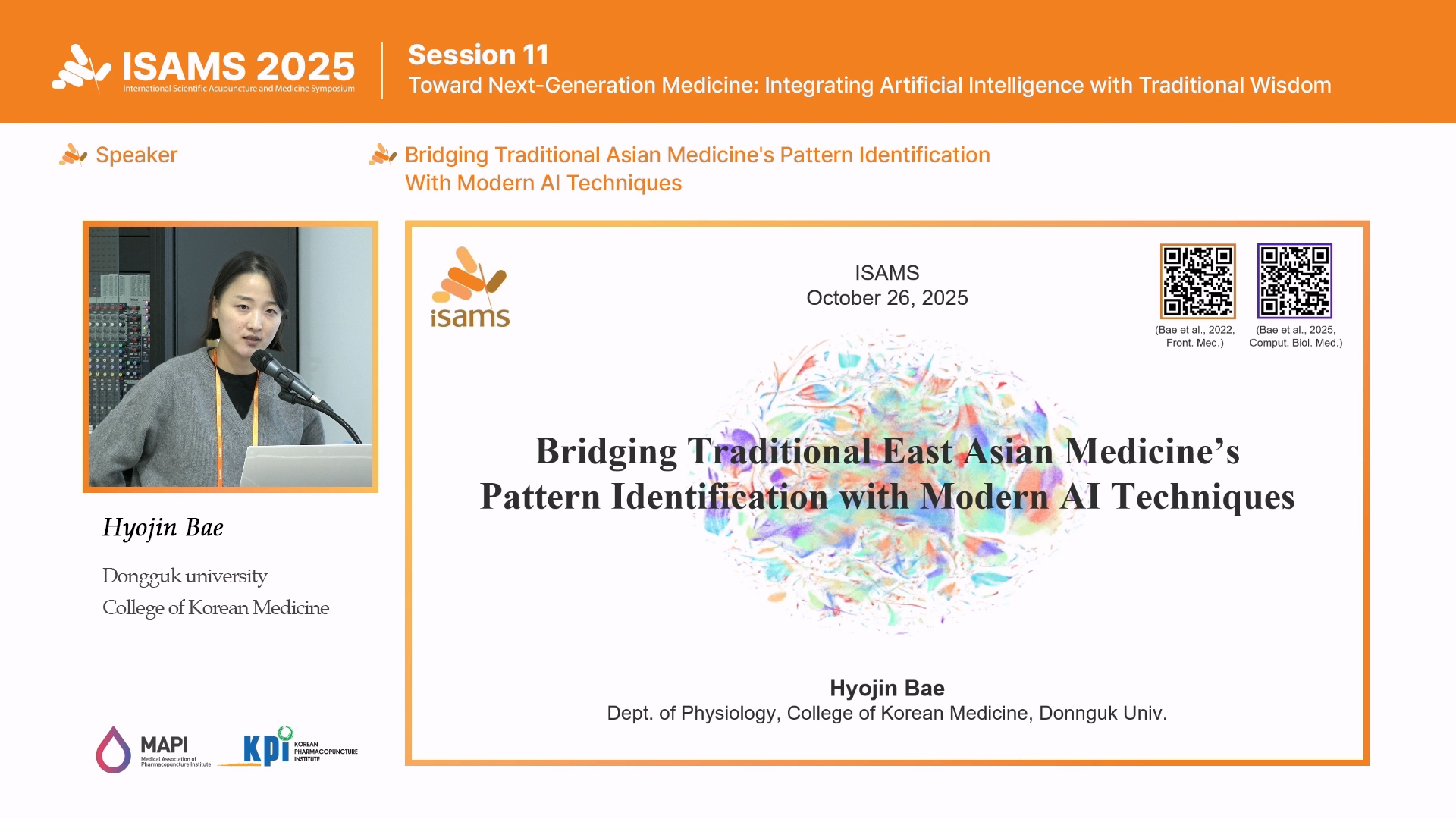
Objectives: This study aimed to examine the clinical decision-making processes in Traditional East Asian Medicine
(TEAM) by reinterpreting pattern identification (PI) as a form of dimensionality reduction. Specifically, we focused on the
Eight Principle Pattern Identification (EPPI) system and investigated why the Exterior–Interior (Ext–Int) pattern is prioritized
in diagnosis and treatment selection.
Methods: We analyzed empirical data from the Shang-Han-Lun and tested three hypotheses: (1) whether the Ext
Int dimension contains the most information about patient symptoms, (2) whether it represents the most abstract and
generalizable symptom information, and (3) whether it facilitates the selection of appropriate herbal prescriptions.
Quantitative measures including abstraction index, cross-conditional generalization performance (CCGP), and
decision tree regression were employed.
Results: The Ext–Int dimension showed the highest abstraction index and generalization capacity, particularly in
the herbal prescription space. Decision tree regression further confirmed its role as a primary node in mapping
symptoms to prescriptions. These findings demonstrate that the Ext–Int dimension provides abstract and generalizable
representations that enhance diagnostic efficiency and treatment selection.
Conclusion: This study provides an objective and quantitative framework for understanding the cognitive processes
underlying TEAM. By formalizing PI as a sequential dimensionality reduction process, our findings highlight the central
role of the Ext–Int pattern in bridging traditional medical reasoning with modern computational approaches. These
insights have implications for the development of AI-driven diagnostic tools and the advancement of clinical practice,
education, and research in both traditional and conventional medicine.
강사소개
Dr. Hyojin Bae is currently an Assistant Professor in the Department of Physiology
at Dongguk University College of Korean Medicine, having joined the faculty in September
2025. She previously served as a Post-doctoral Researcher at Seoul National University College of Medicine from
March 2024. Dr. Bae earned her Ph.D. in Physiology from the Department of Korean Medicine at Gachon University
in 2024, where she conducted research under the supervision of Prof. Chang-Eop Kim, and completed her B.S. in
Korean Medicine at Dongguk University in 2018.
Dr. Bae’s research focuses on elucidating the inductive biases within cerebellar networks that enable efficient and robust
learning, utilizing computational neuroscience approaches and deep neural networks grounded in statistical learning theory.
She is also developing mathematical and computational neuroscience models of Korean Medicine theory. Her interdisciplinary
expertise spans AI theory, neural network modeling, programming, linear algebra, and mathematical statistics.