온라인강의
강사명Chang-Eop Kim
강의시간24분
강의개설일2025-12-10
강의소개
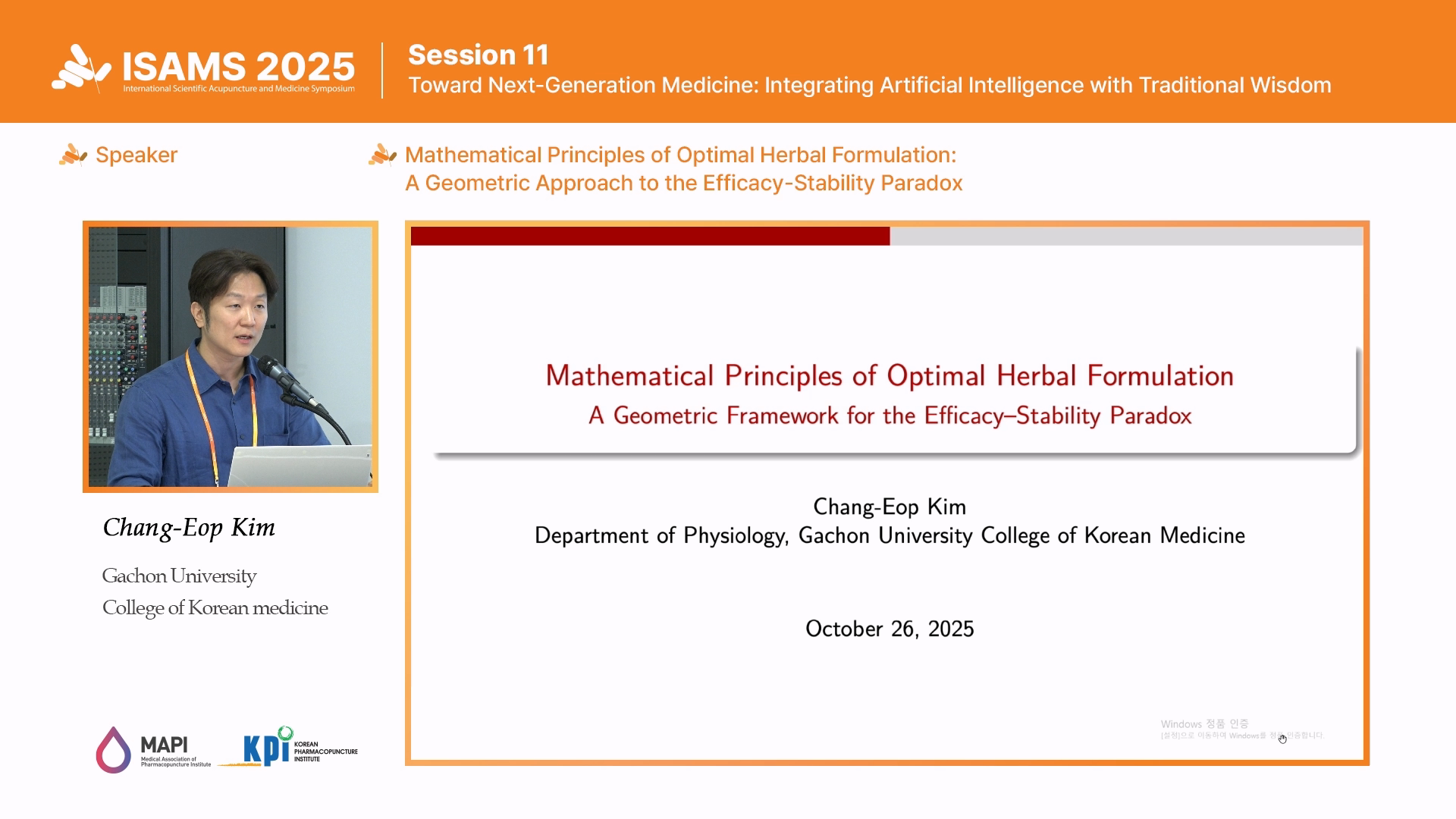
Introduction: The combination of multiple herbs into complex formulas is a foundational principle of East Asian medicine,
intended to produce synergistic therapeutic actions. However, the principles governing how an increase in complexity can
simultaneously enhance both mean efficacy and the stability (i.e., reliability) of the outcome remain largely unexplored. This
work frames this issue as the “”efficacy-stability paradox”” and proposes a quantitative framework to resolve it.
Methods: We introduce a “”Therapeutic Utility Function,”” U(h)=E[f]−λ Var(f), to formalize the trade-off between
maximizing the mean therapeutic effect, E[f], and minimizing the therapeutic variance, Var(f). Pharmacological
interactions are deconstructed into two key components: “”Signal Correlation,”” which governs mean efficacy, and
“”Noise Correlation,”” which determines the formula’s stability. This theoretical model is then grounded in the multi
layer Herb-Compound-Target-Function (H-C-T-F) cascade to provide a mechanistic basis.
Results: Our analysis suggests that an optimal formula is not merely a combination of potent components, but
rather one that is engineered to simultaneously exhibit strong positive signal correlation (to maximize efficacy) and
non-positive, ideally negative, noise correlation (to actively suppress variance). From a geometric perspective, this
framework elucidates an optimal design strategy: for a given noise environment (covariance matrix Σ h), the formula
should be designed such that its therapeutic sensitivity gradient (∇g) is orthogonal to the dominant eigenvectors of the
noise. This is termed the “”Principle of Noise Orthogonality””.
Conclusion: This work provides a new perspective on the principles of complex herbal formulation through the lens
of “”variance engineering””. The proposed framework offers a rational, quantitative language for the empirically
derived art of formulation. By deconstructing pharmacological interactions into components governing efficacy (Signal
Correlation) and stability (Noise Correlation), it provides a principled approach to designing formulas that balance the
pursuit of potency with the critical need for therapeutic reliability. This presents a theoretical basis for transforming the
art of formulation into a modern, quantitative, decision-theoretic process.
강사소개
Dr. Chang-Eop Kim is an Associate Professor in the Department of Physiology
at Gachon University College of Korean Medicine, where he leads a research group at the
intersection of neuroscience, artificial intelligence, and medicine. He holds a diverse educational background with a
Ph.D. in Medical Science (Physiology) from Seoul National University College of Medicine, a B.S. in Korean Medicine
from Dongguk University, and a B.S. in Mathematics. He is also a Certified Physician in Biomedical Informatics (CPBMI).