온라인강의
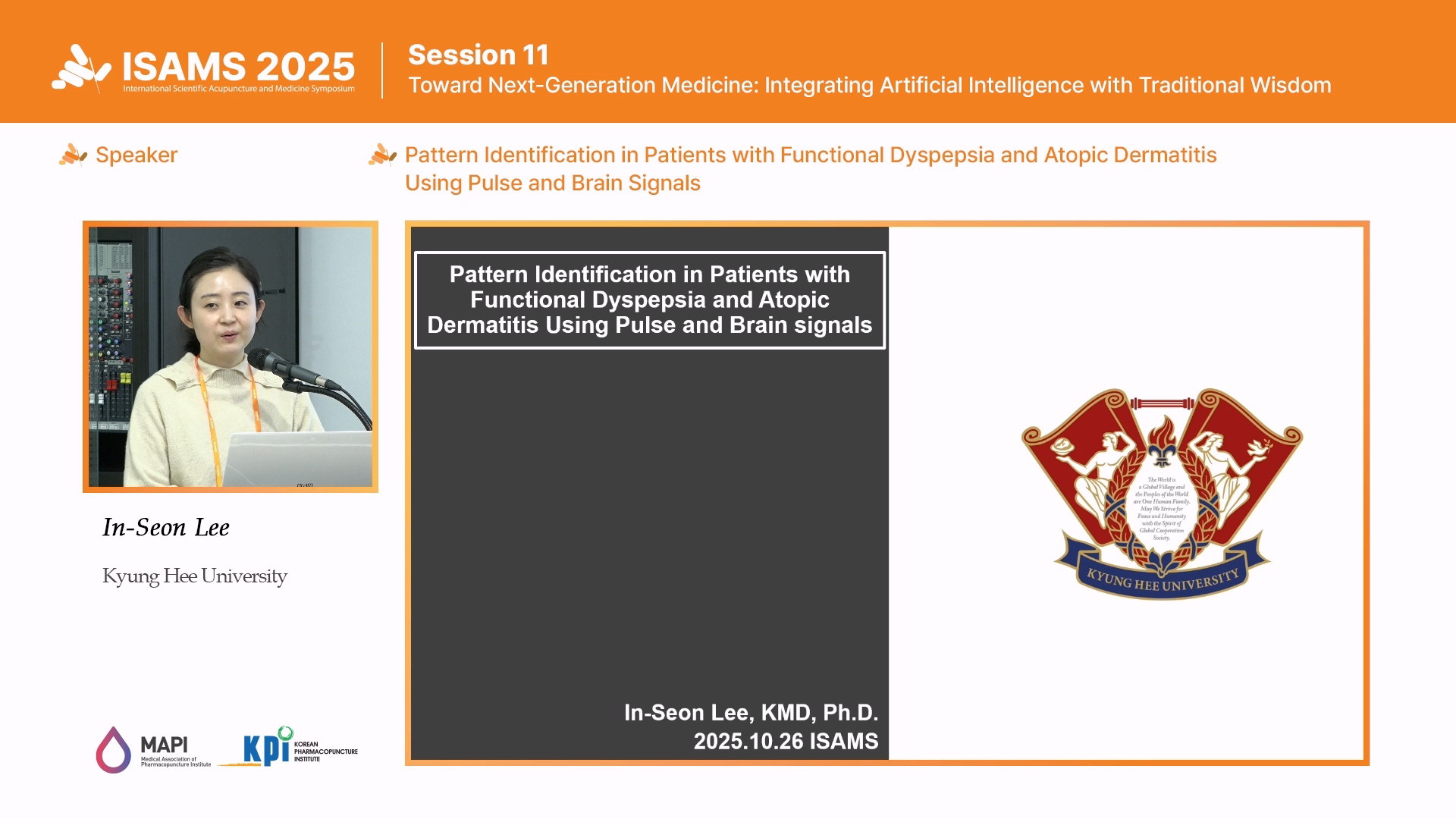
강사명In-Seon Lee
강의시간19분
강의개설일2025-12-10
강의소개
Objectives: Traditional diagnostic methods in Korean Medicine, such as pulse diagnosis and symptom-based pattern
identification, rely significantly on subjective clinician judgment, which limits reproducibility. Meanwhile, conditions
like atopic dermatitis (AD) and functional dyspepsia (FD) involve complex neurophysiological mechanisms that could
benefit from objective, data-driven evaluation. This study aimed to develop machine learning–based biomarkers
from resting-state functional MRI (fMRI) in AD patients and pulse waveform clustering in FD patients, with the goals
of (1) distinguishing patients from healthy controls, (2) predicting treatment response, and (3) assessing concordance
between data-driven and clinician- or questionnaire-based pattern classification.
Methods: In the AD study, 41 patients and 40 healthy controls underwent resting-state fMRI. Signals from 38
functional brain regions were analyzed using a long short-term memory (LSTM) model to extract temporal dynamics,
with bootstrapping and 4-fold cross-validation to evaluate classification performance for disease identification and
acupuncture treatment response. In the FD study, one-minute pulse waveforms from five channels on each wrist of
100 patients were recorded using multi-channel tonometry. After normalization, Time Series K-Means clustering with
Dynamic Time Warping (DTW) was applied in both hard and soft clustering modes. Clustering outcomes for Cold
Heat and Deficiency–Excess patterns were compared to clinician and questionnaire diagnoses using accuracy, cosine
similarity, and Kullback–Leibler divergence.
Results: For AD classification, the LSTM model achieved accuracies ranging from 73% to 85% across key regions—
including the supplementary motor area, posterior cingulate cortex, temporal pole, precuneus, and dorsolateral
prefrontal cortex—exceeding the chance level of 50% with statistical significance (p < 0.05). For acupuncture response
prediction, accuracies reached 71% to 83%, with most predictive regions being the lingual–parahippocampal–fusiform
gyrus, primary motor and somatosensory cortex, paracentral lobule, and frontal gyrus.
In FD patients, pulse waveform clustering showed higher agreement with clinician-assessed patterns than questionnaire
based patterns. Pulse waveform clustering achieved a highest accuracy of 0.75 for Cold–Heat classification at the
fifth channel of the left wrist and 0.60 for Deficiency–Excess classification at the first channel of the right wrist when
compared with clinician diagnoses.
Conclusion: Across two distinct conditions, data-driven physiological signal analysis—whether brain-body signals
from resting-state fMRI or peripheral pulse waveforms—enabled objective classification of disease states and
treatment-related subgroups. Neural biomarkers provided insight into intrinsic brain alterations in AD and supported
personalized acupuncture strategies, while pulse waveform clustering demonstrated potential for AI-assisted pattern
identification in FD. These findings underscore the feasibility of integrating multimodal biosignal analytics into Korean
Medicine diagnostics to enhance objectivity, reproducibility, and precision in patient care. Furthermore, integrating
brain and body signals in a unified analytical framework is expected to further improve the predictive performance of
such models.
강사소개
In-Seon Lee, Ph.D., KMD
Assistant Professor, Department of Korean Medical Science, Kyung Hee University, Seoul, Republic of Korea; inseon.
lee@khu.ac.