온라인강의
강사명Hee Young Kim
강의시간15분
강의개설일2025-12-10
강의소개
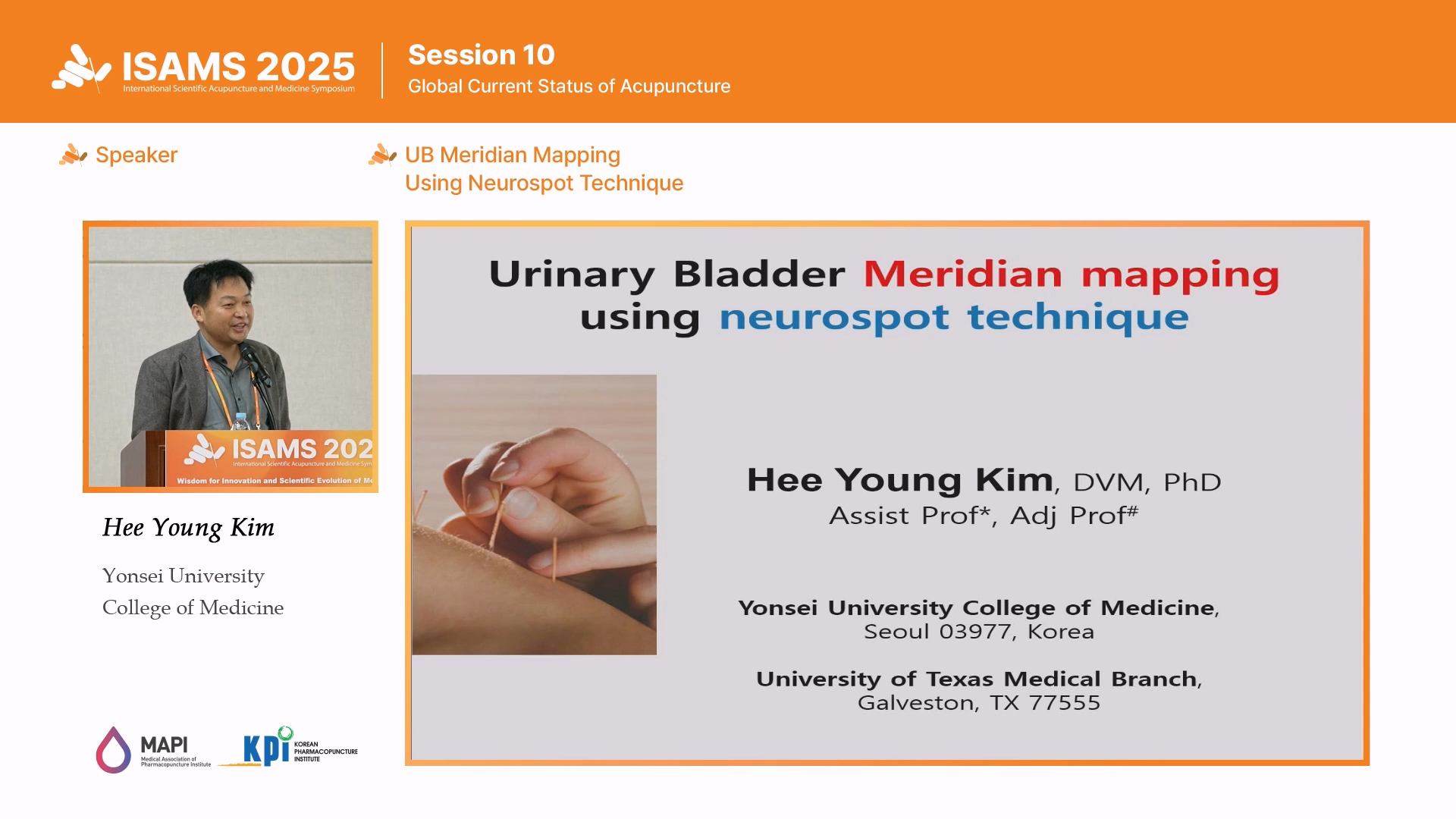
In traditional East Asian medicine, meridians are described as longitudinal pathways connecting acupuncture points
through which qi flows. Despite their central role in clinical practice, these pathways are invisible and their biological
basis has remained elusive. Our laboratory has previously reported that acupuncture points share similarities with
neurogenic spots. The present study investigated the urinary bladder meridian in a rat model of bladder hyperactivity
using the neurospot technique. Bladder hyperactivity was induced by continuous intravesical infusion of physiological
saline, which reliably evoked rhythmic bladder contractions. When Evans blue dye was intravenously injected,
distinct skin regions corresponding to neurogenic spots were revealed and the resulting pattern closely resembled
the traditional Foot Taiyang Bladder Meridian. Functional validation was performed by stimulating these Evans blue
derived spots with electroacupuncture. Stimulation significantly altered bladder activity, indicating that these sites are
functionally relevant to bladder regulation. Moreover, direct stimulation of the spinal nerve 6 (L6) not only suppressed
bladder contractions but also induced the appearance of a meridian-like line along the dermatome. This finding
supports the hypothesis that the Bladder Meridian corresponds to the somatosensory territory of spinal nerve 6.
These results demonstrate that the Foot Taiyang Bladder Meridian may represent a neurophysiological phenomenon
associated with specific spinal segmental innervation. This study provides experimental evidence bridging traditional
meridian theory with modern neuroanatomy and physiology, and suggests that meridian pathways can be mapped
and functionally validated using neurospot-based approaches.
강사소개
Hee Young, Kim, PhD, MS, DVM
Associate Professor, Department of Physiology, Yonsei University College of Medicine, Seoul,
Hee Young Kim received a bachelor degree (1998) and a master science degree (2000) from College of Veterinary
Medicine, Seoul National University (and obtained a PhD degree (2005) from Department of Acupuncture, College of
Korean Medicine, Kyung Hee University, South Korea.
I had worked for Department of Neuroscience and cell biology, University of Texas Medical Branch, Texas, USA from
2006-2011 as Post-doc and Assistant Professor and had been involved in various projects unveiling the mechanism of
acupuncture in pain, that reactive oxygen species (ROS) act as functional signaling molecules in various chronic pains
including neuropathic pain. I came back to Korea as Professor in South Korea 2011 and published more than 100
SCI papers regarding acupuncture mechanisms.