온라인강의
강사명YOUNGIL SONG
강의시간21분
강의개설일2025-12-10
강의소개
Objectives: Uzbekistan possesses a distinctive and longstanding medical tradition rooted in Islamic medicine,
which declined under Soviet rule. Recent initiatives aim to reconstruct traditional medicine and foster international
cooperation, particularly with Korean traditional medicine. However, comprehensive understanding of the historical
and current status of traditional medicine in Central Asia remains limited.
Methods: This study reviews the medical history of Uzbekistan across three periods: the Silk Road era, the Russian and
Soviet period, and the post-independence era. For each period, the socio-cultural context, healthcare infrastructure,
and status of traditional medicine are examined. Recent legal and institutional developments supporting traditional
medicine in the post-independence period are also analyzed.
Results: Uzbekistan traditional medicine evolved under diverse influences, including Islamic, Persian, Greco-Roman,
Indian, and East Asian systems, but was largely dismantled during the Soviet era. Since independence, four laws were
enacted in 2018, 2020, and 2023 to promote traditional medicine. These efforts have led to the establishment of
regulatory frameworks, research institutions, and educational centers dedicated to traditional medicine.
Conclusion: Uzbekistan is actively pursuing the restoration of traditional medicine to strengthen public health and
develop the pharmacological sector. Capacity building through expert training is essential for advancing traditional
medical systems across Central Asia, and Korean traditional medicine may serve as a valuable model in this effort
강사소개
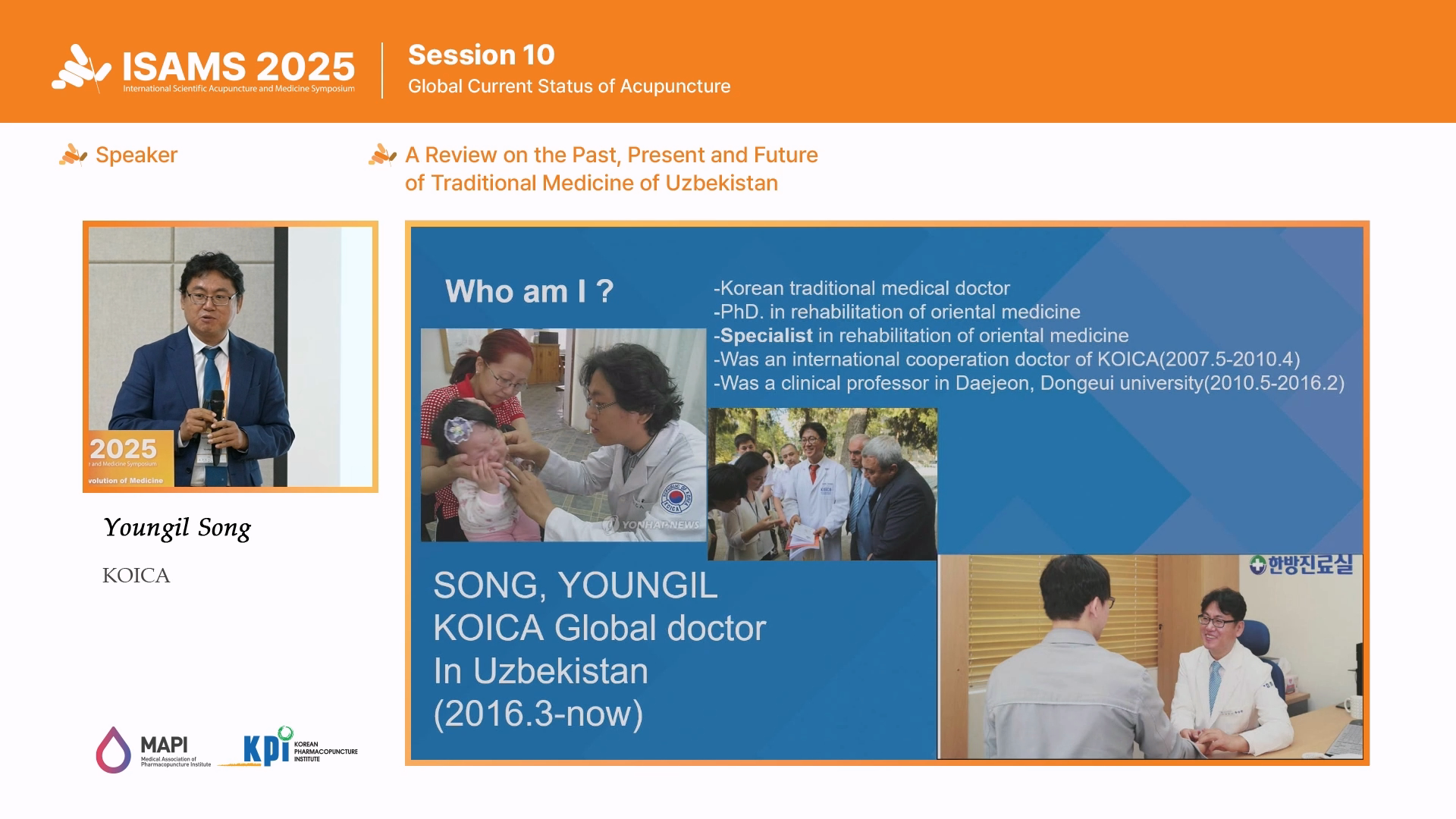
Dr. Youngil Song is a seasoned medical professional and scholar specializing in
Korean Rehabilitation Medicine, currently serving as a Global Doctor for the Korea International
Cooperation Agency (KOICA). Based in Uzbekistan, he plays a pivotal role in advancing integrative medical practices
by leading traditional medicine legislation, education, and research in collaboration with national institutions including
the Republican Scientific and Practical Center of Traditional Medicine and Tashkent Medical Academy.
Dr. Song holds a Ph.D., Master’s, and Bachelor’s degree in Korean Medicine, all from Daejeon University in the
Republic of Korea. Over the past two decades, he has cultivated a unique blend of clinical expertise, academic
rigor, and cross-cultural medical diplomacy. His teaching and clinical work span leading Korean and Uzbek medical
institutions, where he has educated both students and physicians in Korean Rehabilitation Medicine and acupuncture.