온라인강의
강사명Yoonjin Jeong
강의시간4분
강의개설일2025-12-10
강의소개
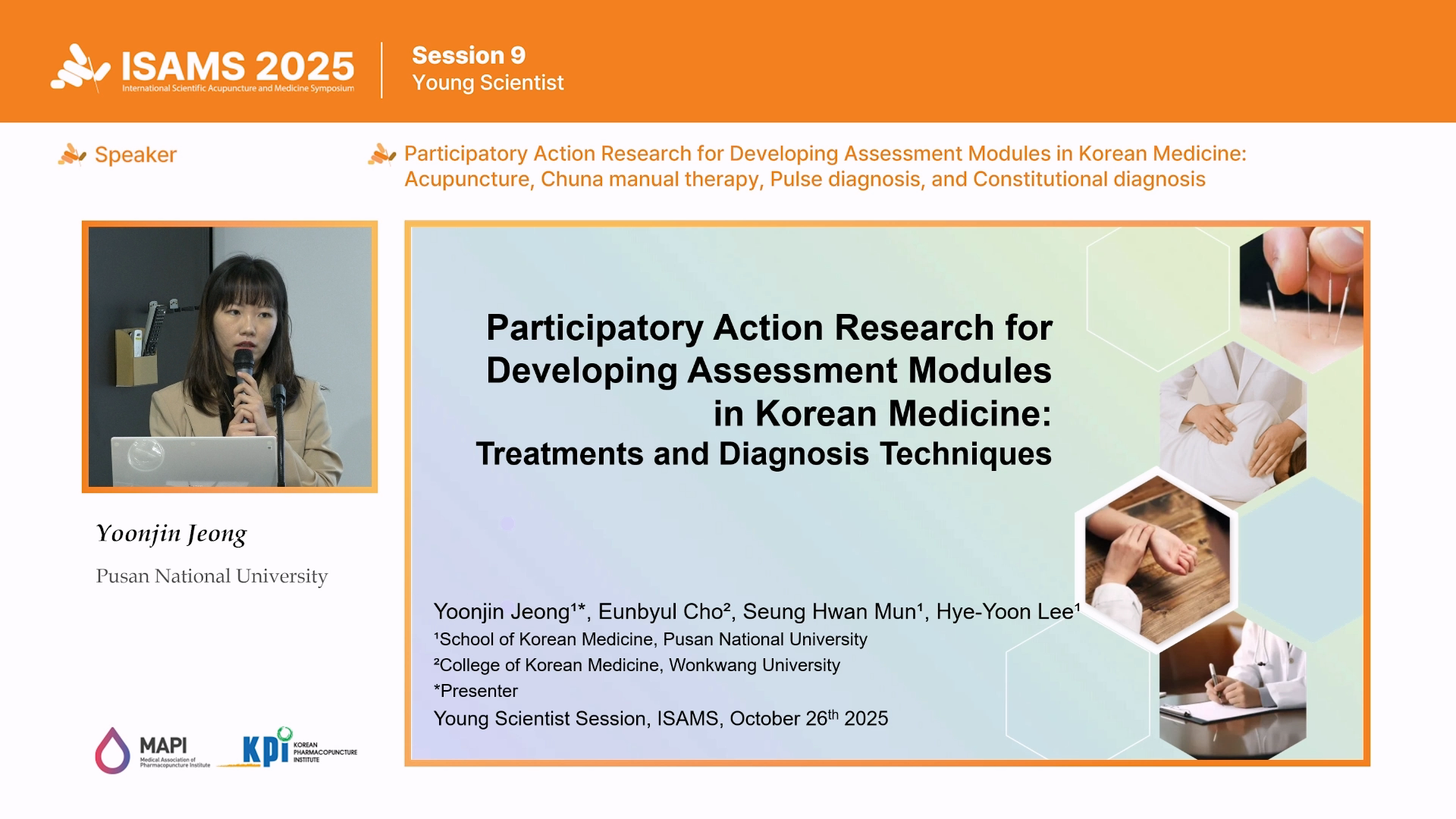
Objectives: Korean medicine requires systematic educational evaluation to ensure the efficacy and safety of its clinical
procedures. However, reliable and valid assessment methods for Korean medicine remain underdeveloped. This
study employed participatory action research (PAR), engaging students, medical education experts, and standardized
patients, to develop assessment modules for two treatment procedures (Acupuncture and Chuna manual therapy) and
two diagnosis procedures (Pulse diagnosis and Constitutional diagnosis).
Methods: Assessment modules were developed based on the suggestions of relevant academic societies and
implemented as examinations for third-year Korean medicine students in their second semester. The modules were
evaluated by medical education experts using the RUMBA checklist, which includes the features of being realistic,
understandable, measurable, behavioral, and achievable. In addition, open-ended feedback was collected from
expert evaluators, student test takers, and standardized patients regarding each module.
Results: The evaluation results were reported both quantitatively and qualitatively. Using the RUMBA checklist, all
four modules received mean scores ≥ 4 for understandable, behavioral, and achievable domains, with acupuncture
scoring ≥ 4 across all RUMBA domains. The measurable domain recorded the lowest scores for Chuna manual
therapy, pulse diagnosis, and constitutional diagnosis. Regarding the necessity of assessment modules, Chuna manual
therapy ranked the highest (mean=5.0). Also, constitutional diagnosis ranked the highest (mean=4.67) for feasibility
in Clinical Skills Assessment (CSA) for the Korean Medicine Doctor (KMD) national licensing examination.
Feedback from expert evaluators was categorized into ‘content and scoring criteria’, ‘physical environment or
simulators’, and ‘education or training’. The evaluators mainly suggested the need for a wider range of needle
manipulations, pulse patterns, and constitutional questions. They also recommended providing test conditions that
ensure clear observation of test takers’ hand movements. In addition, student test takers and standardized patient
provided suggestions primarily concerning the authenticity and safety of the assessment modules. They also raised
concerns about whether the professor could accurately evaluate students’ performance, as test conditions did not always
allow clear observation and some assessment items were overly simple or of low difficulty. The introduction of auxiliary
equipment and the development of assessment methods that can differentiate between students were suggested.
Conclusion: This study developed assessment modules that can be utilized in the CSA for Korean medicine education.
Students contributed the learner’s perspective, medical education experts provided professional analysis, and
standardized patients represented the patient’s perspective. These modules are expected to provide a foundation for
the KMD national licensing examination, ensuring practitioner competency, patient safety, and treatment effectiveness.
강사소개
Yoonjin Jeong is a second-year student in the Department of Korean Medicine at Pusan
National University. She completed her undergraduate studies at Korea University, double majoring in Home
Economics Education and International Studies. Her current research interests focus on medical education and integrative medicine.