온라인강의
강사명Taerim Yun
강의시간6분
강의개설일2025-12-10
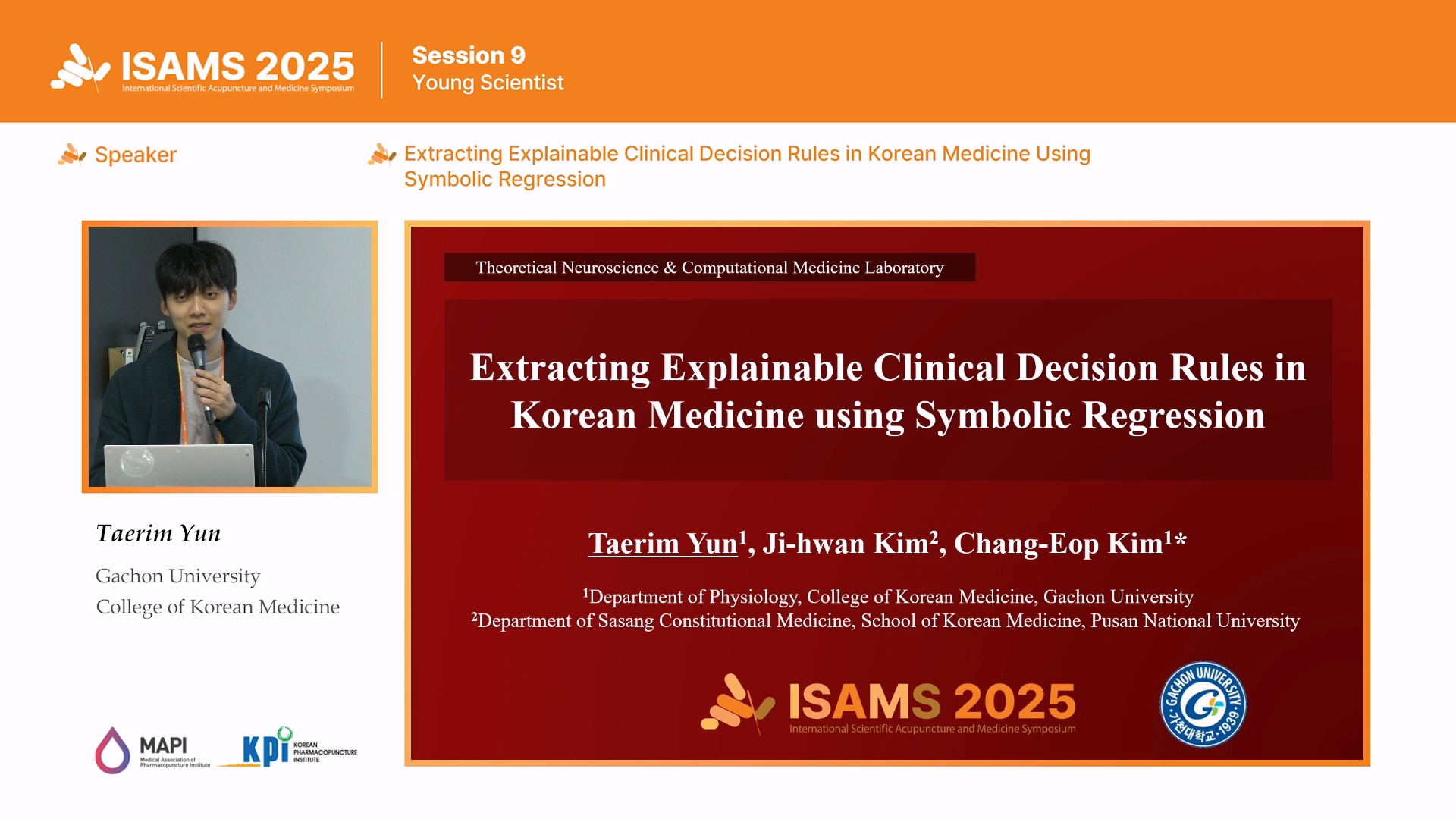
강의소개
Objectives: Since medicine is directly related to human life, there is a substantial legal and ethical responsibility in
diagnosis and treatment decisions. Therefore, in medical AI, not only predictive performance but also explainability of
predictions is critical. If clinicians cannot understand the process or rationale behind AI predictions, the application of
AI in clinical practice will be significantly constrained. The purpose of this study is to construct a framework that extracts
the implicit clinical decision-making processes of Korean Medicine doctors into explicit and interpretable forms using
symbolic regression. Symbolic regression is a technique that represents learning outcomes as analytic expressions such
as equations, providing not only predictive performance but also high explainability of predictions.
Results: Although the environment contained relatively few samples compared to the number of features—making it prone
to overfitting on specific training sets—PySR showed comparable generalization performance to conventional models. In
contrast, PySR demonstrated a remarkable advantage in explainability. It exhibited a richer ability to search for equations
than logistic regression, which is limited to simple linear forms. Unlike tree-based or boosting models that only provide
explanations in terms of feature importance, symbolic regression provided explicit mathematical expressions for class
boundaries, which is a distinct advantage in the medical domain where pattern identification and classification are critical.
Conclusion: Symbolic regression, which represents individual doctors’ decision-making criteria in explicit and
interpretable mathematical forms, holds two major implications. First, it enables doctors to objectively review their own
clinical decision-making criteria, thereby providing clear feedback. Second, by integrating the equations derived from
multiple doctors within the same school of Korean medicine, it allows the formulation of group-level equations, laying
the groundwork for developing school-specific CDSS AI
강사소개
Master’s student of Theoretical Neuroscience & Computational Medicine Lab at
Gachon University, College of Korean Medicine.
Graduated from Kyunghee University, College of Korean Medicine and interested in Medical AI, Computational
Neuroscience, Cognitive Science, Sasang Constitutional Medicine.