온라인강의
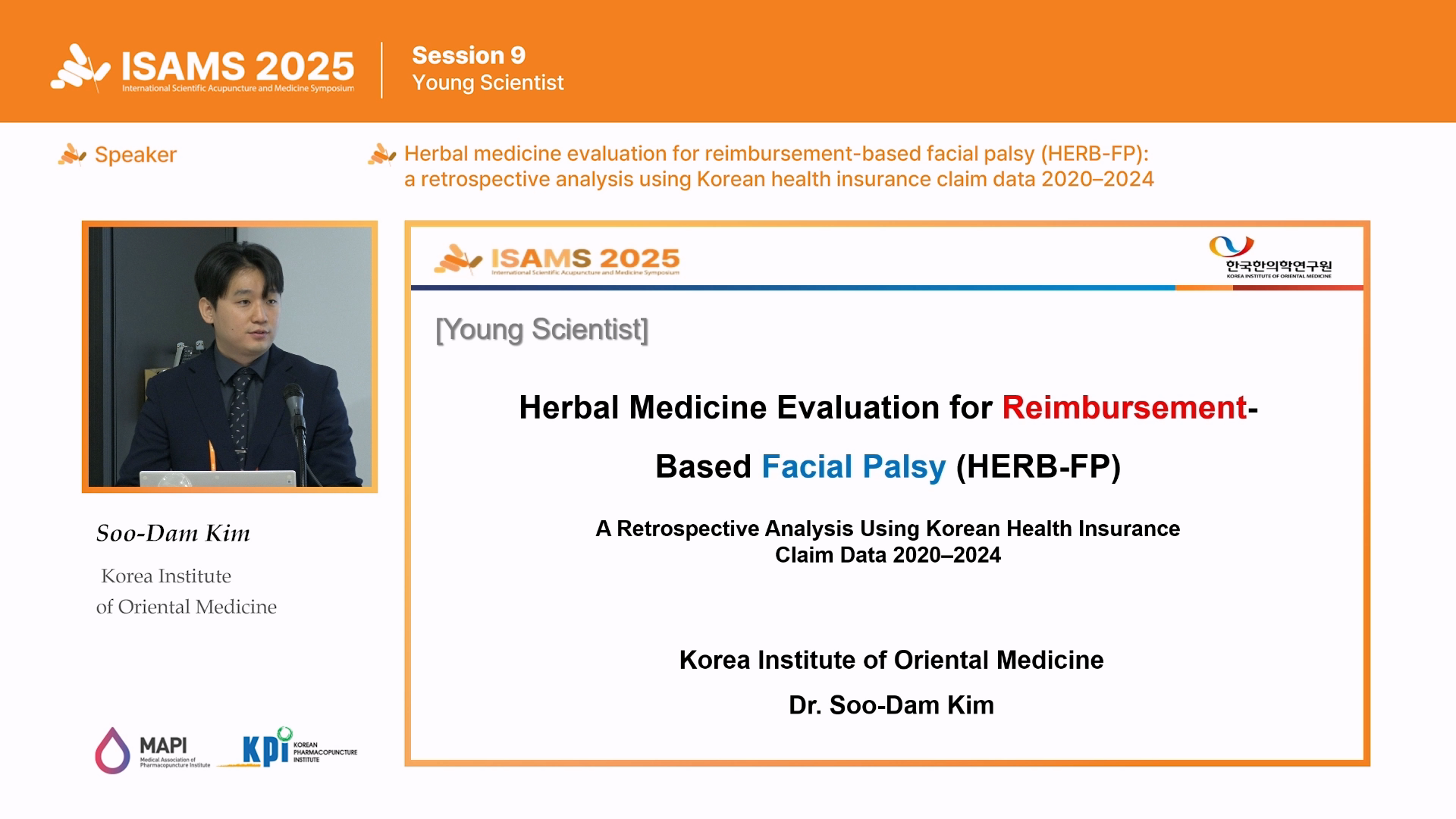
강사명Soo-Dam Kim
강의시간5분
강의개설일2025-12-10
강의소개
Background: Facial palsy (FP) is a neurological condition marked by unilateral facial weakness due to facial nerve dysfunction. In
November 2020, the Korean government launched a pilot reimbursement program for herbal decoctions, expanding insurance
coverage to include treatments traditionally excluded from the national health system. This study aimed to evaluate the real-world
utilization, clinical effectiveness, and safety of herbal medicine (HM) for FP within this national reimbursement program.
Methods: This retrospective study analyzed outpatient claims data from the Health Insurance Review and Assessment
Service (HIRA) between November 2020 and April 2024. Patients diagnosed with FP (KCD code G51.0) from January
2018 onward who received treatment at Korean Medicine (KM) clinics participating in the program were included. Patients
were excluded if they had fewer than two visits or incomplete treatment records. Descriptive and inferential analyses were
conducted to examine patient demographics, treatment patterns, symptom progression, and adverse events (AEs).
Results: A total of 3,927 patients were analyzed (2,174 females and 1,753 males; mean age: 54.2±14.7).
Peripheral FP was reported in 88.9% of cases. Most patients received treatment in outpatient KM clinics, with 56.2%
making two or fewer visits and 36.6% initiating care within two weeks of symptom onset. Ligigeopoong-san (17.0%)
and Gamiboik-tang (14.4%) were the most commonly prescribed formulas. Among patients with symptom severity
scores at both baseline and follow-up (n = 2,161), 49.2% showed improvement, 45.6% remained unchanged, and
5.2% worsened. The overall AE rate was low (1.76%), with gastrointestinal issues being most frequent.
Conclusions: Herbal decoctions prescribed under the Korean pilot reimbursement program for FP showed a low
incidence of adverse events and moderate rates of symptom improvement, suggesting a potentially safe and effective
treatment option based on large-scale real-world data. These findings support the continued integration of herbal
medicine into national health policy. However, limitations include the absence of clinical grading and reliance on
administrative data. As the second-phase program expands in scope and duration, further research should explore its
long-term clinical and economic outcomes to guide evidence-based healthcare policy development.
강사소개
Dr. Soo-Dam Kim is a physician-scientist with expertise in clinical research
methodology, protocol development, and scientific communication. He earned his M.D. and
M.Sc. in Clinical Science of Integrative Medicine from Beijing University of Chinese Medicine, completed his Ph.D. in
Korean Internal Medicine at Daejeon University, and conducted a one-year research fellowship at Memorial Sloan
Kettering Cancer Center (MSKCC) in New York, focusing on integrative oncology and outcomes research. He is
currently a postdoctoral researcher at the Korea Institute of Oriental Medicine and has published 25 peer-reviewed
SCI(E) papers, including numerous first-author works, spanning integrative oncology, registry-based clinical research,
clinical practice guideline development, and real-world evidence generation.