온라인강의
강사명Nguyen Phan Anh
강의시간6분
강의개설일2025-12-10
강의소개
Objectives: Self-regulation of breathing, across traditional medicine systems worldwide, has been recognized
as a practice for health preservation. One clinical application of breathing-based interventions is to support the
management of emotional disorders. For a more comprehensive understanding of these therapeutic effects, we
conceptualize breathing interventions as the behavioral responses to cope with acute mental stress. Therefore, the
present study aimed at investigating the immediate effects of different volitional breathing patterns.
Method: Volitional slow-deep breathing (Vs) and volitional fast-shallow breathing (Vf) were assigned to young females
(mean age = 21.18 ± 1.69 years) during working memory (WM) tasks with emotional distractors.
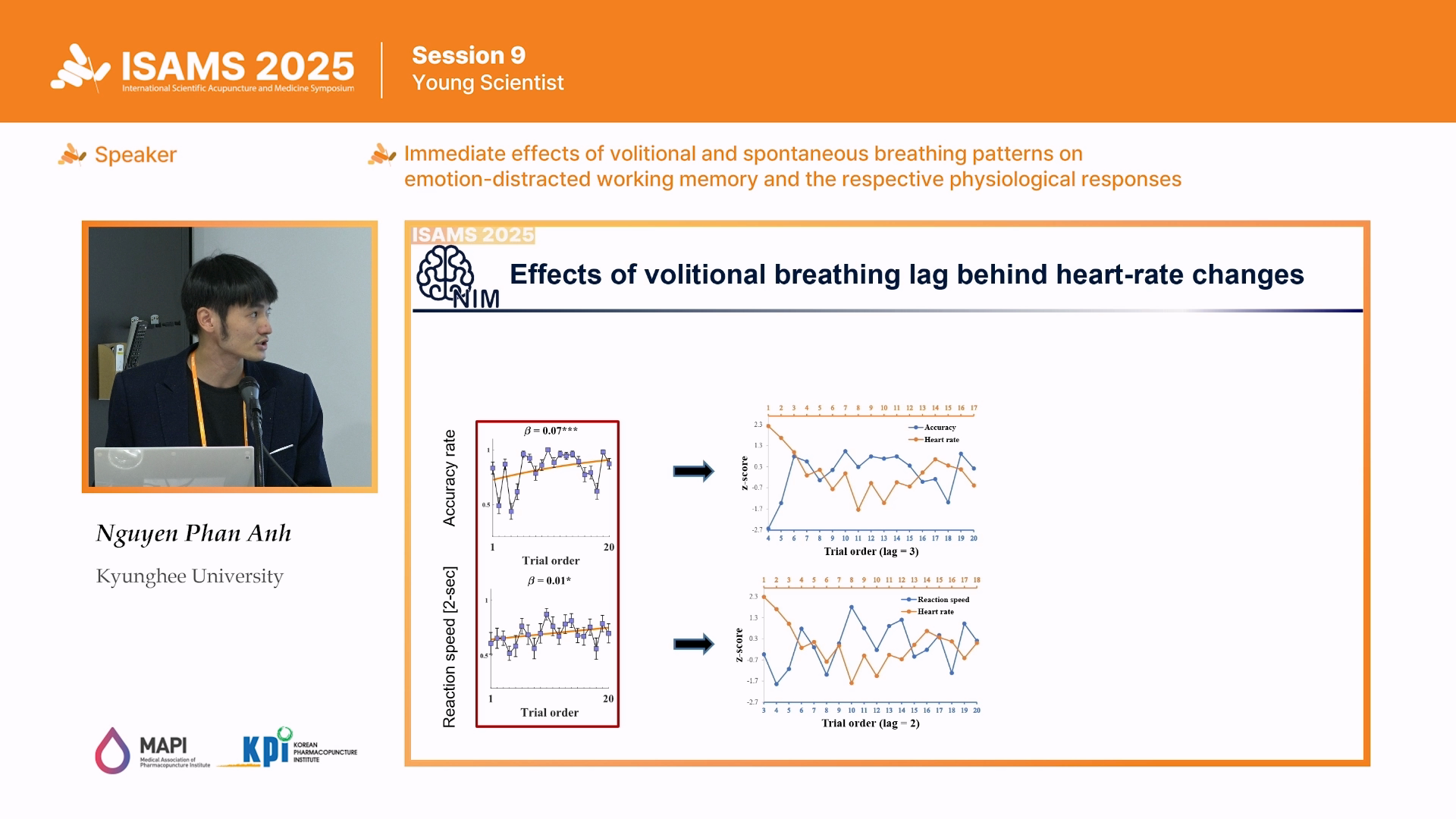
Results & Discussion: Reductions in WM accuracy and reaction speed due to emotional distractors were alleviated
by Vs and spontaneous slow breathing response. On the other hand, Vf increased WM reaction speed but not WM
accuracy, implying an improvement in motor execution rather than in mental functions. Interestingly, effects on the
autonomic nervous system (ANS) of volitional breathing and spontaneous slow breathing resembled the relief of
mental fatigue and the orienting reflex, respectively. These phenomena suggest underlying mechanisms for breathing
interventions.
Summary: Volitional slow-deep breathing and spontaneous slow breathing attenuate emotional distraction.
Meanwhile, the effect of volitional fast-shallow breathing likely facilitates motor function. Especially, concurrent ANS
responses are associated with the beneficial effects of slow breathing patterns during mental stress.
강사소개
Jundong Kim graduated from the College of Korean Medicine, Kyung Hee
University in 2019. He then completed specialist physician training in Ophthalmology,
Otorhinolaryngology, and Dermatology at Korean Medicine Hospital of Kyung Hee University. In parallel, he earned
a Master’s degree in Clinical Korean Medicine from the College of Korean Medicine, Kyung Hee University. Following
his clinical training, he entered the Ph.D. program in the Department of Physiology at Gachon University College of
Korean Medicine.
His research interests lie at the intersection of medical artificial intelligence, computational neuroscience, and traditional
Korean medicine. Specifically, he focuses on modeling physicians’ pattern identification processes using explainable AI
methods and exploring the computational principles of brain systems including the cerebellum and hippocampus.