온라인강의
강사명Jundong Kim
강의시간5분
강의개설일2025-12-10
강의소개
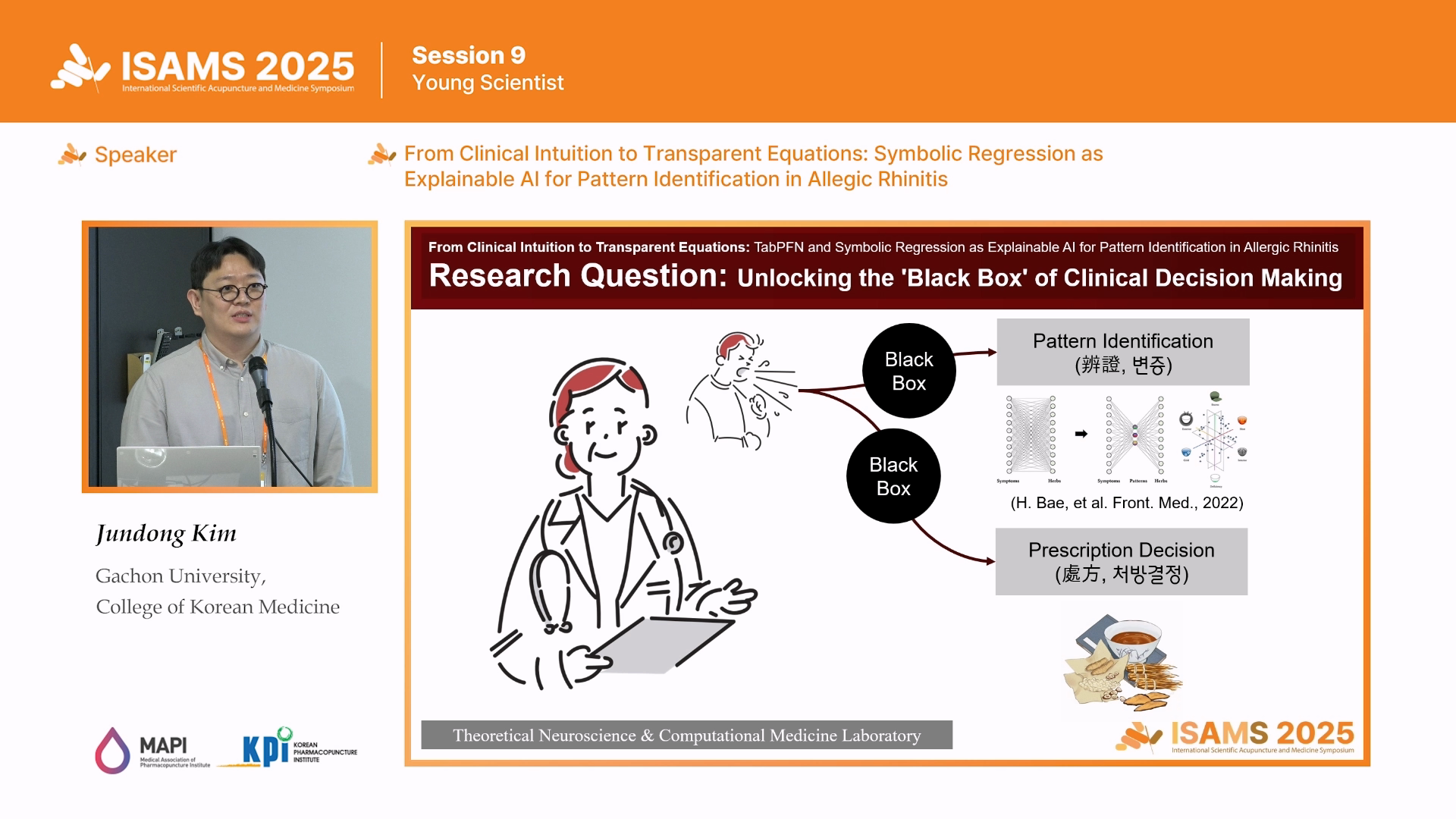
Objectives: Traditional Korean Medicine (TKM) relies on physicians’ pattern identification (PI) to guide the treatment
of allergic rhinitis, but the decision-making process is often considered opaque. This study aimed to reproduce and
explain physicians’ diagnostic reasoning by applying explainable artificial intelligence (XAI), focusing on symbolic
regression models that provide interpretable mathematical expressions.
Methods: We analyzed questionnaire data from 100 allergic rhinitis patients, each labeled by Korean Medicine
doctors with PI categories and prescriptions. Symbolic regression (PySR) was employed to construct classification
functions that mimic physicians’ PI decisions. Unlike black-box models, symbolic regression produces explicit equations,
enabling transparent interpretation of feature contributions.
Results: The models successfully replicated physician decisions across three PI categories (Lung Cold, Lung Heat,
Spleen Qi Deficiency). The final symbolic equations were as follows:
* f0(x) = x16 / (x10 + x5) (Lung Cold)
* f1(x) = 0.5351 * x12 + 0.6227 * x12 (Lung Heat)
* f2(x) = (x12 * x7 + x19) * 0.1102 (Spleen Qi Deficiency)
For example, in the Lung Cold equation, x16 represents a preference for warm water, and x10 and x5 reflect nasal
color and obstruction severity. Such explicit formulas provided interpretable links between symptoms and diagnostic
categories, clarifying the hidden logic in physicians’ reasoning.
Conclusion: This study demonstrates the potential of symbolic regression as an XAI method to model and elucidate
traditional medical decision-making. By bridging clinical expertise with interpretable computational models, our
approach offers a pathway toward transparent, reproducible, and data-driven integration of TKM diagnostics into
modern clinical practice.
강사소개
Jundong Kim graduated from the College of Korean Medicine, Kyung Hee University
in 2019. He then completed specialist physician training in Ophthalmology, Otorhinolaryngology,
and Dermatology at Korean Medicine Hospital of Kyung Hee University. In parallel, he earned a Master’s degree in
Clinical Korean Medicine from the College of Korean Medicine, Kyung Hee University. Following his clinical training, he
entered the Ph.D. program in the Department of Physiology at Gachon University College of Korean Medicine.
His research interests lie at the intersection of medical artificial intelligence, computational neuroscience, and traditional
Korean medicine. Specifically, he focuses on modeling physicians’ pattern identification processes using explainable AI
methods and exploring the computational principles of brain systems including the cerebellum and hippocampus.