온라인강의
강사명Inhu Bae
강의시간5분
강의개설일2025-12-10
강의소개
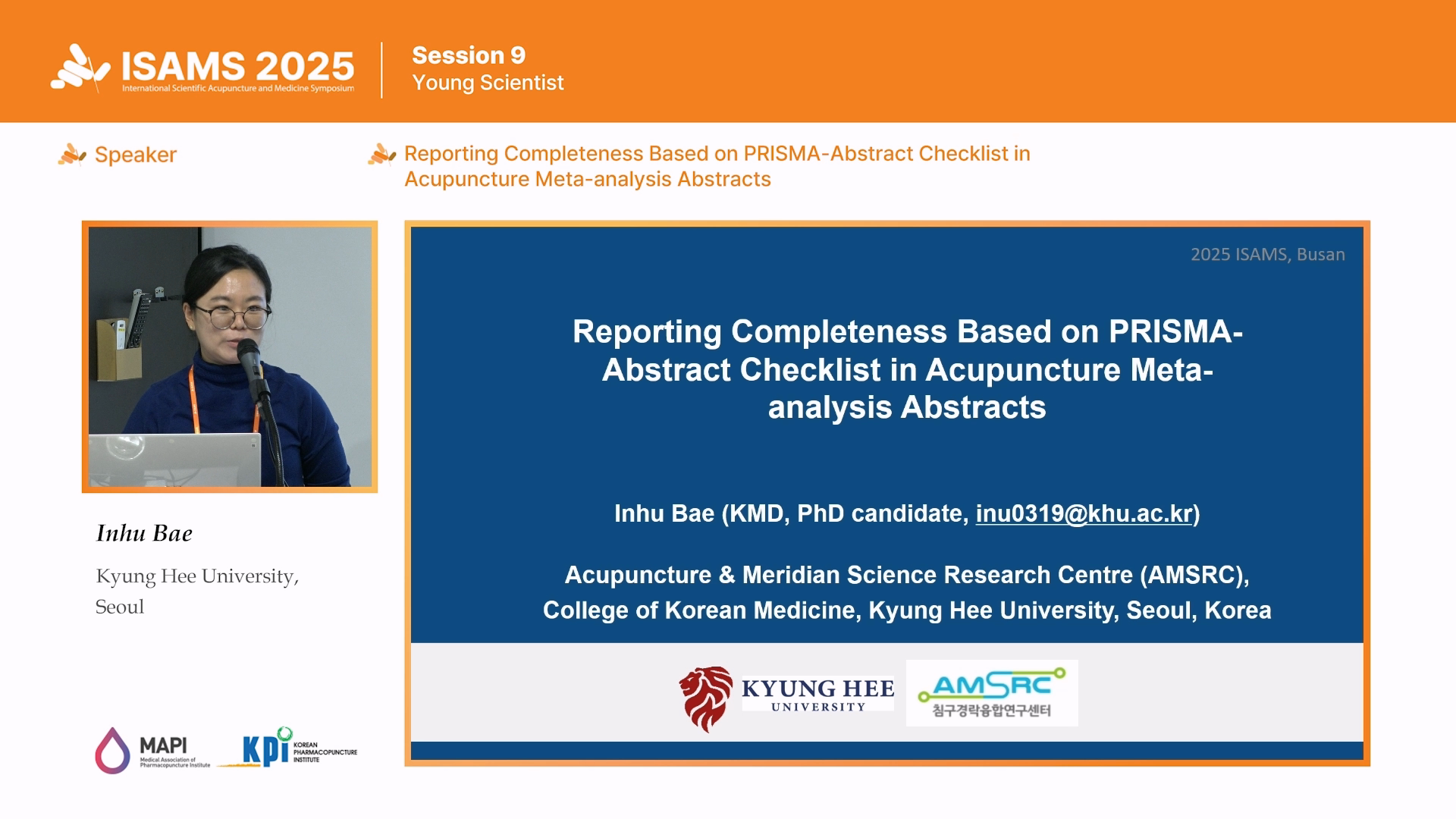
Objectives: As it has been reported that many researchers only read abstracts, abstracts should report all necessary
information, to avoid misinforming readers. The Preferred Reporting Items for Systematic Reviews and Meta-Analyses 2020
for Abstract (PRISMA-Abstract) was developed to enhance the reporting completeness of abstracts. However, research on
the actual level of reporting completeness in acupuncture meta-analysis (MA) abstracts remains limited. This study aims to
assess the reporting completeness of acupuncture MAs using PRISMA-Abstract and identify associated factors.
Conclusion: The reporting completeness of the abstracts of the acupuncture MAs shows room for improvement,
particularly in limitations, interpretation and important implications, which are important for interpreting and applying
the results in clinical settings. However, contrary to previous studies, articles by China-affiliated authors and CAM
journals had higher reporting completeness. PRISMA compliance declarations or checklist submissions were not
significant influencing factors suggesting that authors’ actual understanding may be limited. Adequate training and
specific journal policies are needed to enhance acupuncture MA abstract reporting
강사소개
A PhD candidate at the Acupuncture and Meridian Science Research Center,
College of Korean Medicine, Kyung Hee University. She earned a K.M.D. and an M.S. in Korean
Internal Medicine from Kyung Hee University and is a board-certified specialist in internal Korean
medicine. Her current research interests include methodological evaluation in acupuncture research, transparent reporting,
and reporting completeness.