온라인강의
강사명Go Woon Lee
강의시간5분
강의개설일2025-12-10
강의소개
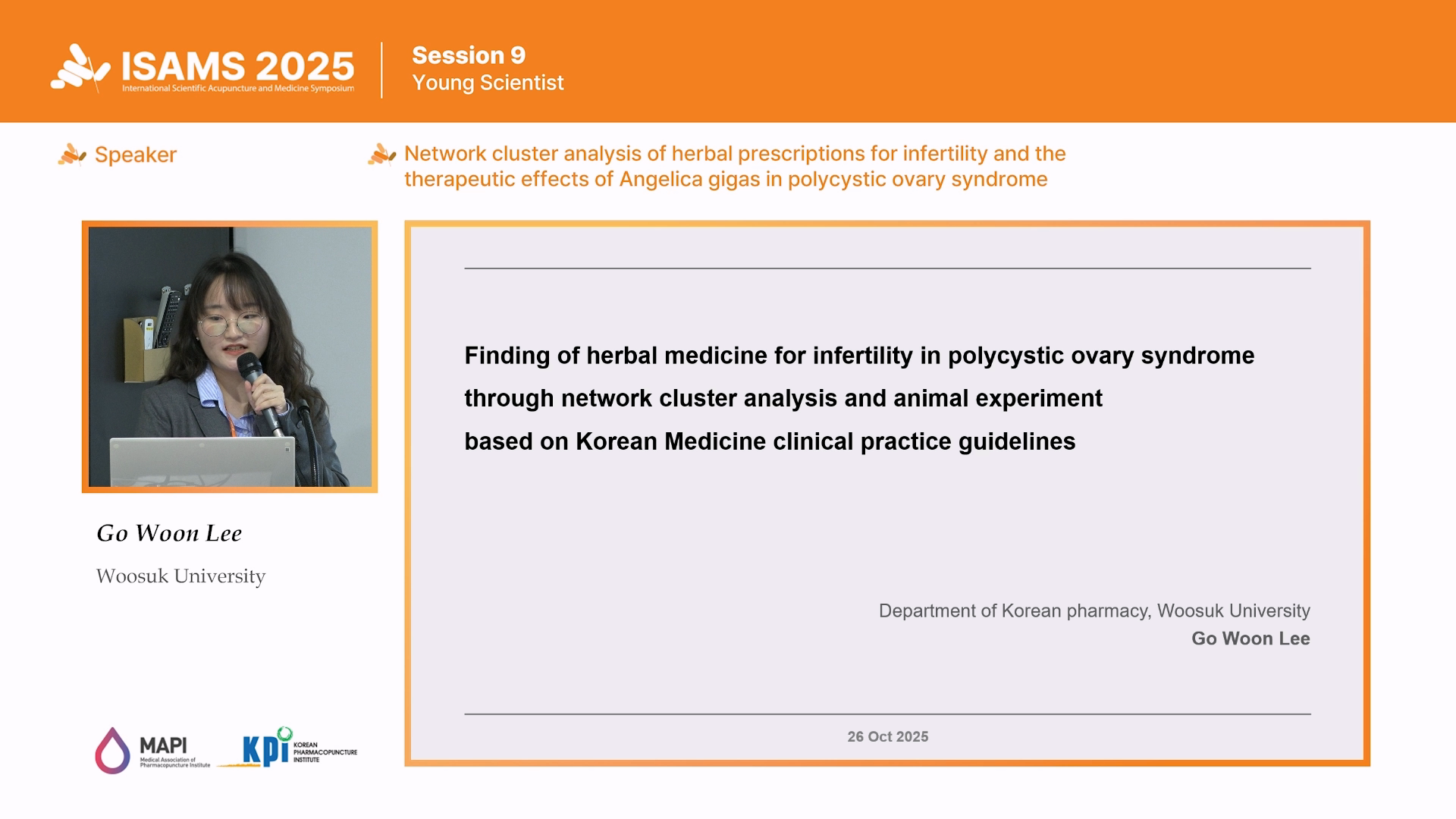
Objectives: PCOS is a common and heterogeneous endocrine disorder and one of the causes of infertility. We
analyzed herbal prescriptions for female infertility, as defined by pattern identifications in the Korean Medicine Clinical
Practice Guidelines (KM-CPGs). By applying network analysis, we identified commonly used formulas, mapped key herb
relationships, and explored core combinations. Based on the results of the network analysis, we investigated the therapeutic
effects of Angelica gigas (AG), a medicinal herb frequently used in the treatment of infertility, using experimental rat model
of polycystic ovary syndrome (PCOS), complemented by network pharmacology and molecular docking analyses.
Methods: We selected 18 prescriptions listed in Korean Medicine Clinical Practice Guidelines for female infertility
and conducted a network cluster analysis to examine their interrelationships. Using Netminer 4, centrality analysis was
conducted to identify influential nodes, and clustering analysis was employed to determine groups of herbs that are
frequently used together. To confirm the efficacy of AG on PCOS, we constructed gene set related to AG and PCOS
and performed functional protein network analysis to identify targets with the highest degree values. Eventually, the
therapeutic effects of AG in PCOS were evaluated using an estradiol valerate-induced experimental rat model. The
number of cystic follicles were counted in Hematoxylin and eosin-stained ovarian tissues.
Results: The core herbs such as Angelica Gigas Radix, Paeonia lactiflora Pallas, Glycyrrhiza uralensis Fischer, and Cnidium
officinale Makino also ranked high in centrality, indicating their significance in the treatment of infertility. Among them,
AG is expected to regulate the AMPK pathway, longevity-regulating pathway, PI3K-Akt pathway, non-alcoholic fatty liver
disease, adipocytokine signaling and FoxO signaling in KEGG Pathways through enrichment analysis with its 11 core
genes. And INS, LEP and IGF1 were selected as the 3 target genes with the highest value of decursin and decursinol, main
components of AG. Molecular docking showed decursin and decursinol has high and stable binding affinities on INS, LEP
and IGF1. Moreover, EV-induced PCOS rats exhibited the decrease of cystic follicle number with the regulation of AMPK
signaling pathway, as well as inhibition of INS, LEP and IGF1 gene expressions in ovarian tissues.
Conclusion: We confirmed the therapeutic effects of AG, which was suggested to be effective for infertility based on
network cluster analysis. While our previous study investigated its relevance at the network analysis level, the present
study further predicted its mechanisms using network pharmacology and molecular docking, and experimentally
validated its therapeutic effects on PCOS. These results demonstrate that analytical approaches such as network
pharmacology, clustering, and molecular docking can be effectively used to identify novel therapeutic prescriptions and
hub targets for disease treatment.
강사소개
2022.03.-the present the stuent of Department of Korean Pharmacy, Woosuk
University