온라인강의
강사명Nishida Motohiro
강의시간26분
강의개설일2025-12-10
강의소개
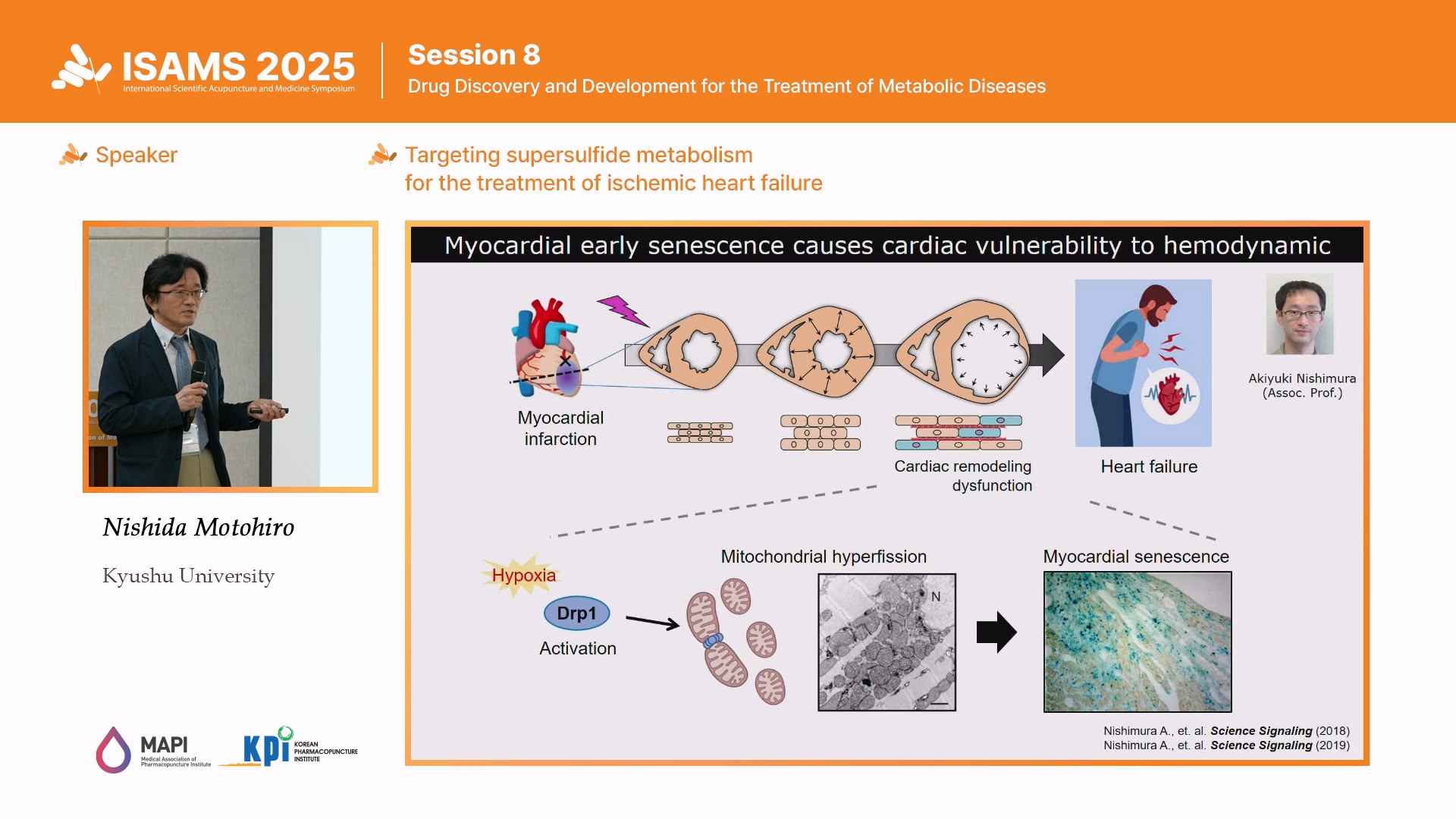
Sulfur-based redox signaling has long been attracted attention as critical mechanisms underlying the development
of cardiac diseases and resultant heart failure. Especially, post-translational modifications of cysteine (Cys) thiols in
proteins mediate oxidative stress-dependent cardiac remodeling including myocardial hypertrophy, senescence, and
interstitial fibrosis. However, we recently revealed the existence of Cys persulfides and Cys polysulfides in cells and
tissues, and these catenated sulfur molecules (supersulfide) substantially contribute to redox signaling and energy
metabolism by exerting unique redox dynamics. We have established simple evaluation methods that can detect
polysulfides in proteins and inorganic polysulfides in cells. We found that polysulfides in healthy hearts are dramatically
catabolized by exposure to ischemic/hypoxic and environmental electrophilic stress, leading to vulnerability of the
heart to mechanical load. Accumulation of hydrogen sulfide, a nucleophilic catabolite of persulfides/polysulfides,
is well associated with myocardial remodeling, and perturbation of polysulfide catabolism can improve myocardial
remodeling and dysfunctions after myocardial infarction in mice. These results suggest that prevention of supersulfide
catabolism during ischemic/hypoxic stress becomes a new therapeutic strategy for the treatment of ischemic heart
failure.
강사소개
Dr. Motohiro Nishida completed the doctoral program at the University of Tokyo
(Graduate School of Pharmaceutical Sciences) in March 2001. His doctoral thesis was
‘Endogenous cardioprotective signaling activated by oxidative modification of Gαi and Gαo proteins’. Specializing
cardiovascular pharmacology and physiology, he experienced an Assistant Professor at the National Institute for
Physiological Sciences (NIPS) in National Institutes of Natural Sciences, an Associate Professor at Kyushu University,
and became a Professor at NIPS from 2013. He became a cross-appointment Professor at Kyushu University,
Graduate School of Pharmaceutical Sciences from 2015. From 2020, he also became a Director at the Drug
Discovery Research Center of Graduate School of Pharmaceutical Sciences, Kyushu University. He has consistently
studied on the CysSH modification-dependent regulation of G protein signaling in the heart, including heterotrimeric
Gi family proteins (Nature 2000), H-Ras small GTPase (Nature Chem. Biol., 2012) and dynamin-related G protein
Drp1 (Nature Commun., 2017; Sci. Signal, 2019; Nature Commun, 2025). He establishes a semi-quantitative bio
imaging technique using supersulfide-selective fluorescence probes and proteomic analysis to detect endogenous
supersulfidated proteins in cells and tissues. He also studies on Zn2+-permeable TRPC channels contributing to
baroreflex-dependent enhancement of cardiac positive inotropy (Nature Commun, 2022).