온라인강의
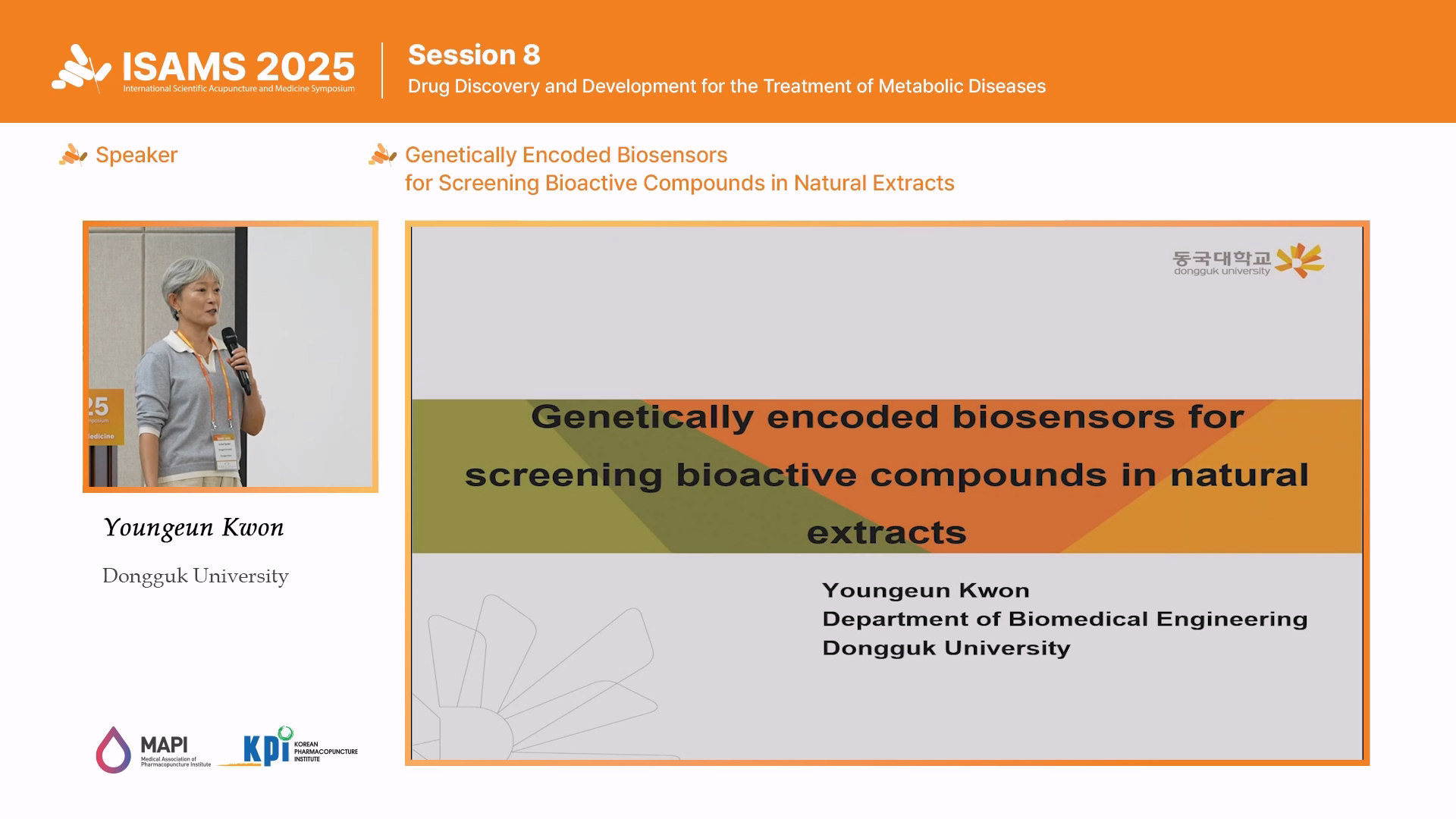
강사명Youngeun Kwon
강의시간25분
강의개설일2025-12-10
강의소개
Objective: In vitro biosensors are limited in capturing biologically relevant molecular interactions. We aimed to
develop genetically encoded, live-cell biosensors for function-based screening of bioactive compounds from natural
extracts.
Method: Sensor cells were engineered using split intein-mediated protein trans-splicing and trans-cleavage, activating
fluorophore-tagged signal peptides upon target recognition. Cortisol-, estrogen-, and EGF-detecting sensor cells were
constructed and tested with known agonists, antagonists, and natural products, including pharmacopuncture materials.
Result: GR sensor cells identified cortisol, dexamethasone, and novel agonists from medicinal plant extracts, including
decursin as a selective glucocorticoid receptor agonist (SEGRA). Screening of pharmacopuncture materials revealed
additional GR effectors. ER sensor cells enabled functional discovery of estrogenic compounds from natural sources,
while EGF sensor cells discriminated agonists and antagonists and monitored downstream Ca²⁺ signaling. The system
eliminated false positives associated with conventional split reporter assays and provided rapid, specific, and sensitive
detection.
Conclusion: Intein-mediated live-cell biosensors represent a versatile platform for function-guided screening of
complex natural extracts. By enabling the discovery of selective receptor agonists and monitoring of signaling cascades,
these biosensors hold strong potential for drug discovery and chemical biology applications.
강사소개
Dr. Youngeun Kwon is a Professor in the Department of Biomedical Engineering
at Dongguk University, Seoul, Republic of Korea. She earned her B.S. and M.S. degrees in
Chemistry from Korea University and received her Ph.D. in Bioorganic Chemistry from the University of Chicago. She
continued her training as a Postdoctoral Scientist at Lawrence Livermore National Laboratory and later worked as a
Senior Engineer at the Samsung Advanced Institute of Technology before joining Dongguk University in 2009.
Her research focuses on intein-mediated protein engineering, live-cell biosensors, and nanomedicine. Specifically,
her group develops genetically encoded sensor cells for real-time, function-based monitoring of signaling pathways
and for screening bioactive compounds from natural extracts. She has published in leading journals such as Nature
Nanotechnology, Biomaterials, and Analytical Chemistry, and currently leads projects supported by the National
Research Foundation of Korea to advance live-cell biosensing technologies for biomedical applications.