온라인강의
강사명Keon Wook Kang
강의시간24분
강의개설일2025-12-10
강의소개
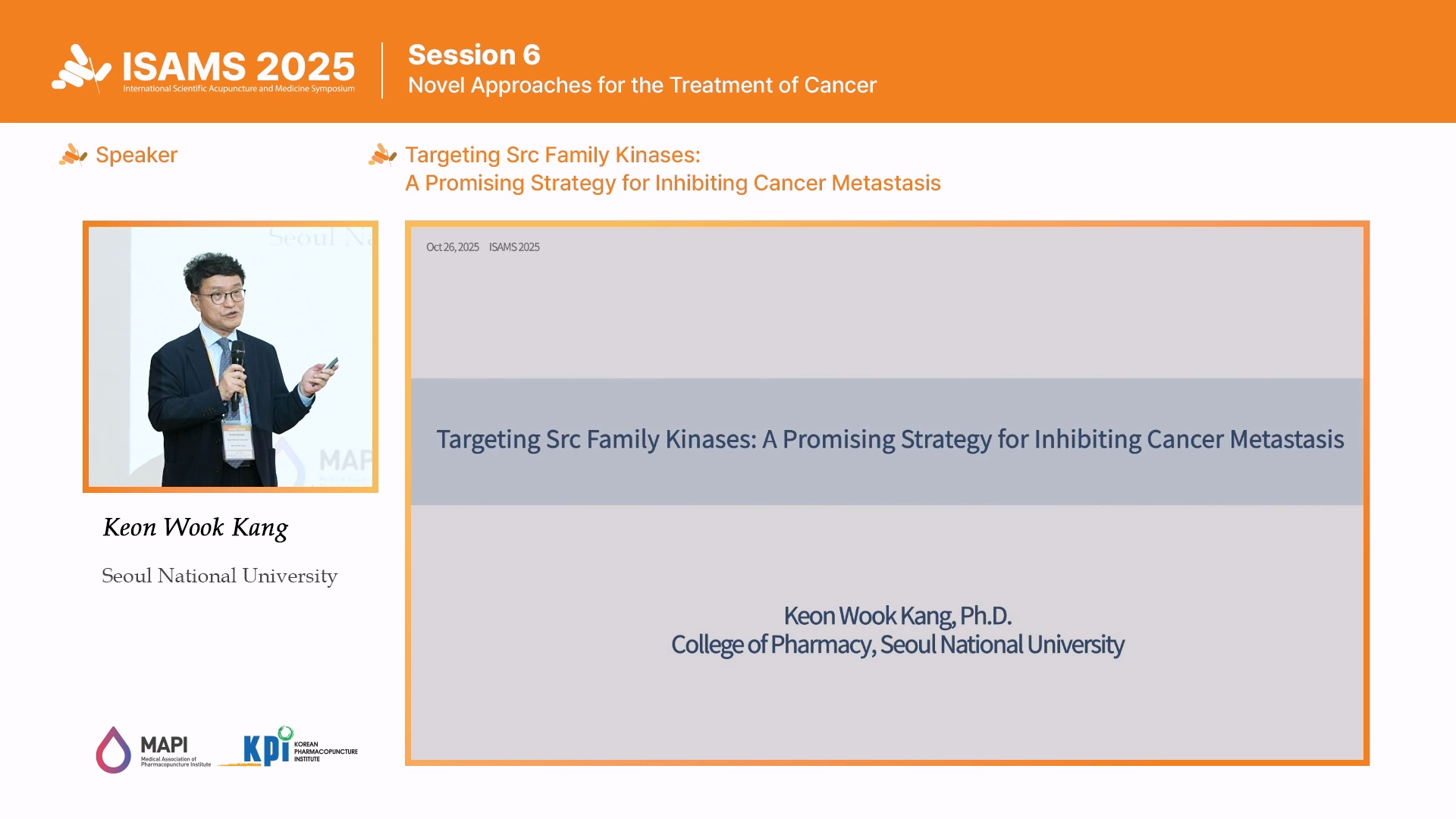
Radiotherapy is a widely employed technique for eradication of tumor using high-energy beams, and has been applied
to approximately 50% of all solid tumor patients. However, its non-specific, cell-killing property leads to inevitable
damage to surrounding normal tissues. Recent findings suggest that radiotherapy-induced tissue damage contributes to
the formation of a pro-tumorigenic microenvironment. In the present study, we used two organ-targeted radiotherapy
models to uncover the mechanisms underlying the development of the radiotherapy-induced microenvironment.
Radiotherapy-induced tissue damage stimulates infiltration of monocyte-derived macrophages and their differentiation
into M2 macrophages, ultimately leading to fibrosis and the formation of a pro-tumorigenic microenvironment. Notably,
SRC family kinases (SFKs) emerged as crucial factors in the formation of the radiotherapy-induced pro-tumorigenic
microenvironment. SFKs activation in epithelial cells and fibroblasts was triggered by direct exposure to irradiation or
M2 macrophage cytokines. Remarkably, the administration of SFK-targeted inhibitors reversed myofibroblast activation,
effectively ameliorating fibrosis and the pro-tumorigenic microenvironment in radiated tissues. Further, combined
administration of radiotherapy and SFK-targeted inhibitors significantly enhanced the survival of tumor-bearing mice.
Overall, reshaping the tissue microenvironment by targeting SFKs is a potential strategy for preventing metastasis and
recurrence following radiotherapy. The finding that clinically imperceptible damage can trigger a pro-tumorigenic
microenvironment suggests the need for combining SFK-targeted inhibitors with radiotherapy. This work was supported
by the National Research Foundation of Korea (NRF) grant (RS-2024-00346965) funded by the Korea government.
강사소개
Dr. Keon Wook Kang is a Professor of the College of Pharmacy, Seoul
National University and is currently serving as the Dean of the College of Pharmacy at
Seoul National University. He entered the College of Pharmacy at Seoul National University as an undergraduate
in 1989, earning his master’s degree from the same institution in 1995, and his Ph.D. in Pharmacology in 1999.
Afterward, Dr. Kang worked as a postdoctoral researcher at the New Drug Development Research Center at Seoul
National University and at the University of California, Irvine, in the United States. In 2003, he was appointed as a full
time faculty member at College of Pharmacy, Chosun University. In September 2011, he was appointed as an associate
professor at College of Pharmacy, Seoul National University, and since 2017, he has served as the Associate Dean for
Students and the Associate Dean for Academic Affairs at the same institution. Since 2020, he has also been serving as
the Deputy Director of the Office of Admissions, Seoul National University. In terms of academic society activities, he
is currently the Senior Vice President of the Korean Society of Toxicology and has previously served as the Chair of the
Academic Affairs Committee of the Korean Pharmaceutical Society.