온라인강의
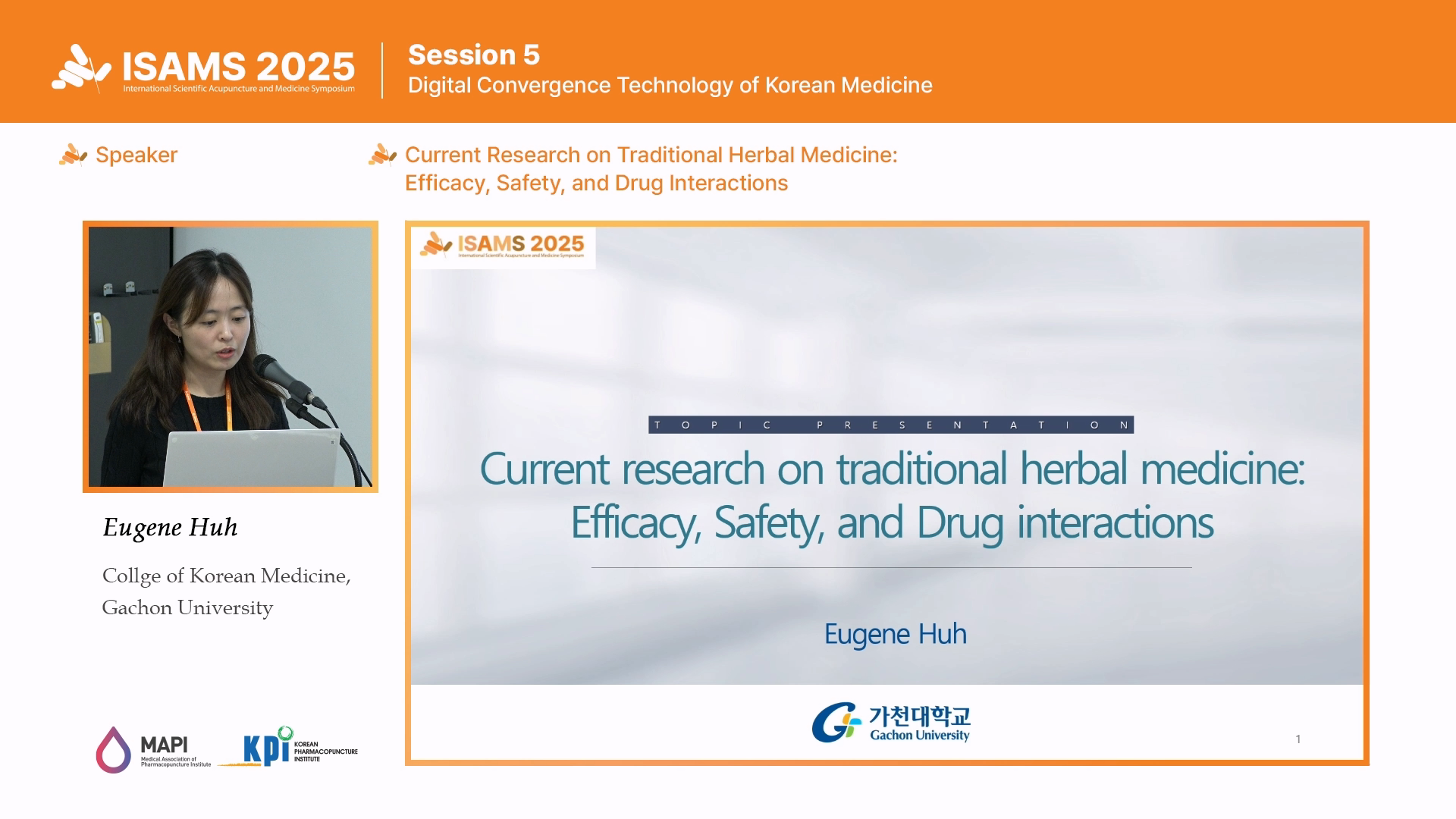
강사명Eugene Huh
강의시간25분
강의개설일2025-12-10
강의소개
Objective: This study conducted a systematic review of drug interactions among Korean insurance herbal medicines and
performed experimental validation of hepatoprotective interactions with acetaminophen, along with genotoxicity assessments
to establish evidence-based safety guidelines for clinical practice.
Methods: A systematic literature review was performed using PubMed, Google Scholar, and Web of Science databases,
identifying 27 eligible studies from 2,011 initial records. For experimental validation, hepatoprotective effects of Korean medicine
(BJIKT) were evaluated in HepG2 cells. Cell viability, combination index (CI), cytochrome P450 enzyme expression, reactive
oxygen species (ROS) levels, and glutathione (GSH) content were assessed. In vivo studies examined CYP enzyme expression in
mouse liver tissue following acetaminophen administration with BJIKT treatment. Genotoxicity evaluation was also conducted.
Results: The systematic review revealed that BST was among the most extensively studied formulations (6 studies), demonstrating
safe combination profiles with anticoagulants and beneficial effects in reducing chemotherapy-induced oral mucositis.
Experimental validation of BJIKT showed significant hepatoprotective effects against acetaminophen-induced toxicity. In HepG2
cells, BJIKT combined with acetaminophen demonstrated strong protective effects (CI = 0.38), while lower concentrations showed
no interaction (CI = 1.00). BJIKT significantly reduced acetaminophen-induced CYP2E1 expression, decreased ROS production,
and restored GSH levels. In vivo studies confirmed that BJIKT modulated hepatic CYP enzyme expression, particularly reducing
acetaminophen-induced CYP2E1 and CYP1A2 upregulation while maintaining CYP2D6 and CYP3A4 at physiological levels.
Genotoxicity assessments revealed no mutagenic potential for either BJIKT or BST across all test systems.
Conclusions: These findings establish evidence-based foundations for safer integration of traditional Korean medicines with
conventional therapies and support the use of specific formulations as adjuvant therapy.
강사소개
Dr. Eugene Huh is an Assistant Professor in the Department of Formulae Pharmacology
at Gachon University College of Korean Medicine, Republic of Korea. She earned her Ph.D. in
Medical Science of Meridian from Kyung Hee University in 2021, where she specialized in Korean medicine with a focus
on neurodegenerative diseases. Dr. Huh’s research expertise encompasses herb-drug interactions, drug delivery systems,
pathophysiology of neurodegenerative diseases, and the microbiota-gut-brain axis in neurodegeneration. She has made
significant contributions to Parkinson’s disease research, particularly investigating neuroprotective mechanisms and levodopa
induced dyskinesia through natural compounds. With over 40 peer-reviewed publications in high-impact journals and four
patents related to neurodegenerative disease treatment and diagnosis, Dr. Huh has established herself as a leading researcher
in the field of traditional medicine applications for neurological disorders. She is currently the principal investigator of a Korea
Health Technology R&D Project focusing on herbal medicine efficacy, safety guidelines, and drug interaction databases.