온라인강의
강사명Byung Tae Choi
강의시간23분
강의개설일2025-12-10
강의소개
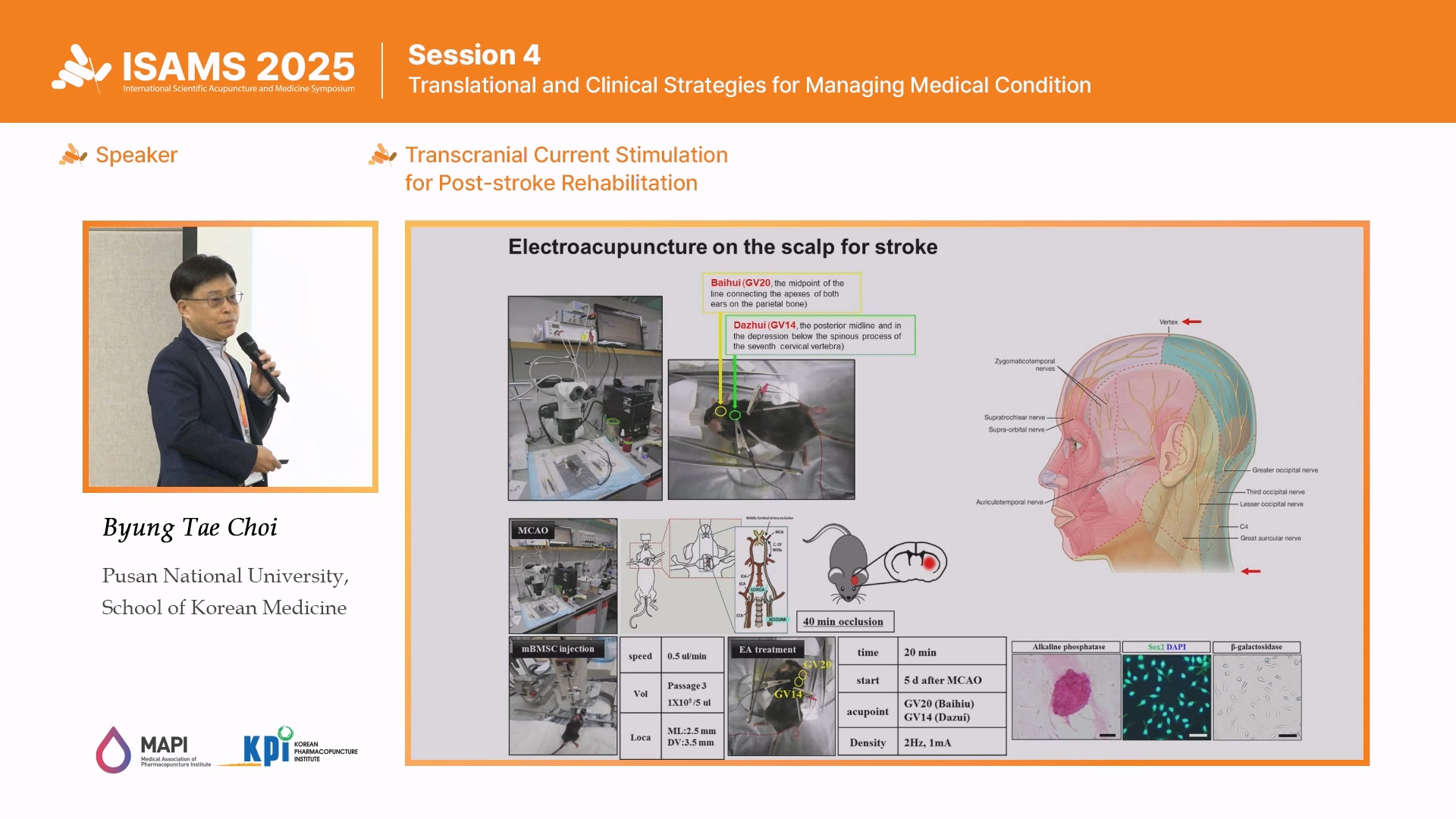
Non-invasive brain stimulation (NIBS), including transcranial current stimulation (tCS), is an emerging therapeutic approach
for effective cortical stimulation in stroke rehabilitation, offering potential functional recovery with minimal side effects.
1. The proper therapeutic configuration of electrodes for post-stroke treatment: We found that anodal high-definition
transcranial direct current stimulation (HD-tDCS) to the contralesional cortex was more effective in attenuating motor
and cognitive deficits than ipsilesional stimulation at early stages of ischemic stroke. This application results in higher
expression of growth factors such as growth/differentiation factor 5 (GDF5) and platelet-derived growth factor subunit
A (PDGFA) in the ipsilesional site. Moreover, these receptors were mainly observed to be expressed in peri-infarct
regions.
2. Novel electrode for tDCS by conjugating a needle to a conventional ring-based HD electrode to enhance cortical
stimulation intensity and focality: The new HD-tDCS application, showing a higher electrical potential and spatial
focality based on computational modeling, revealed better therapeutic effects in alleviating behavioral deficits with
decreased infarct volume and inflammatory response. As a potent factor of therapeutic effect, the different electrode
configurations in the new HD electrode commonly ameliorated neuronal death in the peri-infarct region via N-methyl
D-aspartate-dependent sterol regulatory element-binding protein 1 (NMDA-dependent SREBP1) signaling and related
inflammatory factors, thus further alleviating motor and cognitive deficits following stroke.
3. High-definition transcranial alternating current stimulation (HD-tACS) applied to the unaffected hemisphere
alongside exercise therapy: Both HD-tACS and exercise therapy mitigated motor impairment and substantially
decreased infarct volume. LC-MS/MS proteomic analysis of the peri-infarct region identified five crucial mitochondria
related proteins—Ndufa13, Atp5o, Atp5c1, Atp11b, and Ak4—that were common pathways between HD-tACS
and exercise, as well as two regulators of apoptosis—Bax and Bcl-2. Furthermore, both therapies typically facilitated
neuronal survival in the peri-infarct area by augmenting mitochondrial complex subunits (Ndufa13 and Atp5o) and
modulating phagocytic response, primarily through CD47–SIRPα interactions.
In conclusion, the therapeutic use of tCS induces long-term changes in cortical excitability, e.g., the secretion of activity
dependent growth factors. And tCS treatment applied to the healthy hemisphere, in accordance with the bimodal
balance-recovery model, promotes functional recovery primarily by promoting growth factor expression, reducing
neuronal death, and enhancing mitochondrial activity in the peri-infarct region.
강사소개
Professor, Pusan National University, School of Korean Medicine
Director, BK21 Graduate Training Program of Korean Medicine for Healthy Aging