온라인강의
강사명Hyuk Soon Kim
강의시간30분
강의개설일2025-12-10
강의소개
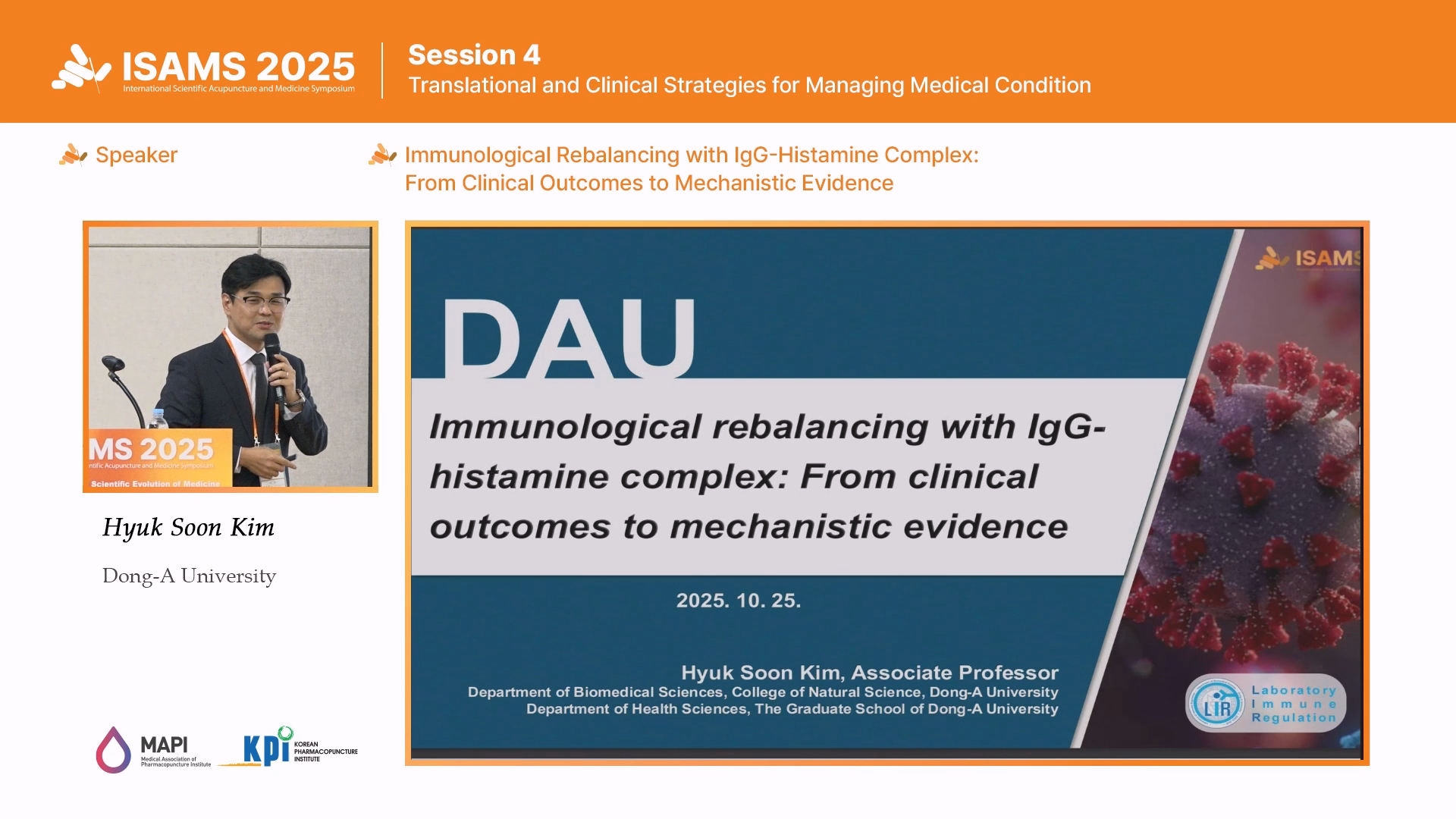
Objectives: Histamine has traditionally been recognized as a mediator that must be blocked in allergic responses.
However, in the IgG-histamine complex (Histobulin), it paradoxically induces immune tolerance. While intravenous
immunoglobulin (IVIG) exerts immunomodulatory functions through Fcγ receptor blockade and induction of regulatory
pathways, the IgG-histamine complex uniquely provides histamine-driven tolerogenic effects. This study aimed to
investigate both the clinical efficacy and mechanistic evidence underlying this paradoxical role of histamine.
Methods: Clinical outcomes were evaluated in patients with chronic spontaneous urticaria, psoriasis, atopic dermatitis,
and primary eosinophilic colitis who received Histobulin therapy. In parallel, in vitro and in vivo experiments were
conducted to examine the effects of histamine pretreatment on mast cells. FcεRI-mediated degranulation, inflammatory
cytokine release, and passive cutaneous/systemic anaphylaxis responses were analyzed.
Results: Histobulin induced rapid clinical improvement and sustained remission in multiple patients, with some maintaining
disease-free status for over one year. Mechanistically, histamine pretreatment suppressed FcεRI-mediated phosphorylation
cascades in mast cells, activated SHP-1–mediated dephosphorylation, and significantly reduced degranulation and systemic
anaphylaxis. These findings indicate that repeated histamine exposure induces immune tolerance rather than hypersensitivity.
Conclusion: The IgG-histamine complex shows significant clinical efficacy across allergic and autoimmune conditions, supported
by mechanistic evidence of histamine-induced mast cell tolerance. Future studies will clarify whether its tolerogenic effects converge
with or diverge from IVIG-mediated immunomodulation, particularly in Fcγ receptor–bearing innate immune subsets.
강사소개
Dr. Hyuk Soon Kim is an Associate Professor in the Department of Biomedical Sciences
at Dong-A University, Busan, Korea. He received his B.Sc. in Biological Sciences from Konkuk
University, and earned his M.S. and Ph.D. degrees in Immunology from the Department of Medicine, Konkuk University. He
subsequently served as an Assistant Professor at Konkuk University School of Medicine (2013–2020) before joining Dong-A
University, where he has continued to advance translational immunology research.
Dr. Kim’s primary research interests are focused on elucidating immune regulatory mechanisms and developing therapeutic
strategies for allergic and autoimmune diseases. His group has identified and characterized novel subsets of regulatory
immune cells, such as regulatory B cells, regulatory NK cells, and regulatory ILCs, and investigated antibody-based therapeutics
with emphasis on mast cell regulation and histamine-mediated immune tolerance. Beyond his research activities, Professor
Kim contributes to the scientific community as an Associate Editor of Genes & Genomics, an Advisory Board Member of the
International Journal of Molecular Sciences, and a peer reviewer for multiple international journals. He has presented his work
at national and international symposia and continues to bridge fundamental immunology with clinical applications.