온라인강의
강사명Min-jung Lee
강의시간20분
강의개설일2025-12-10
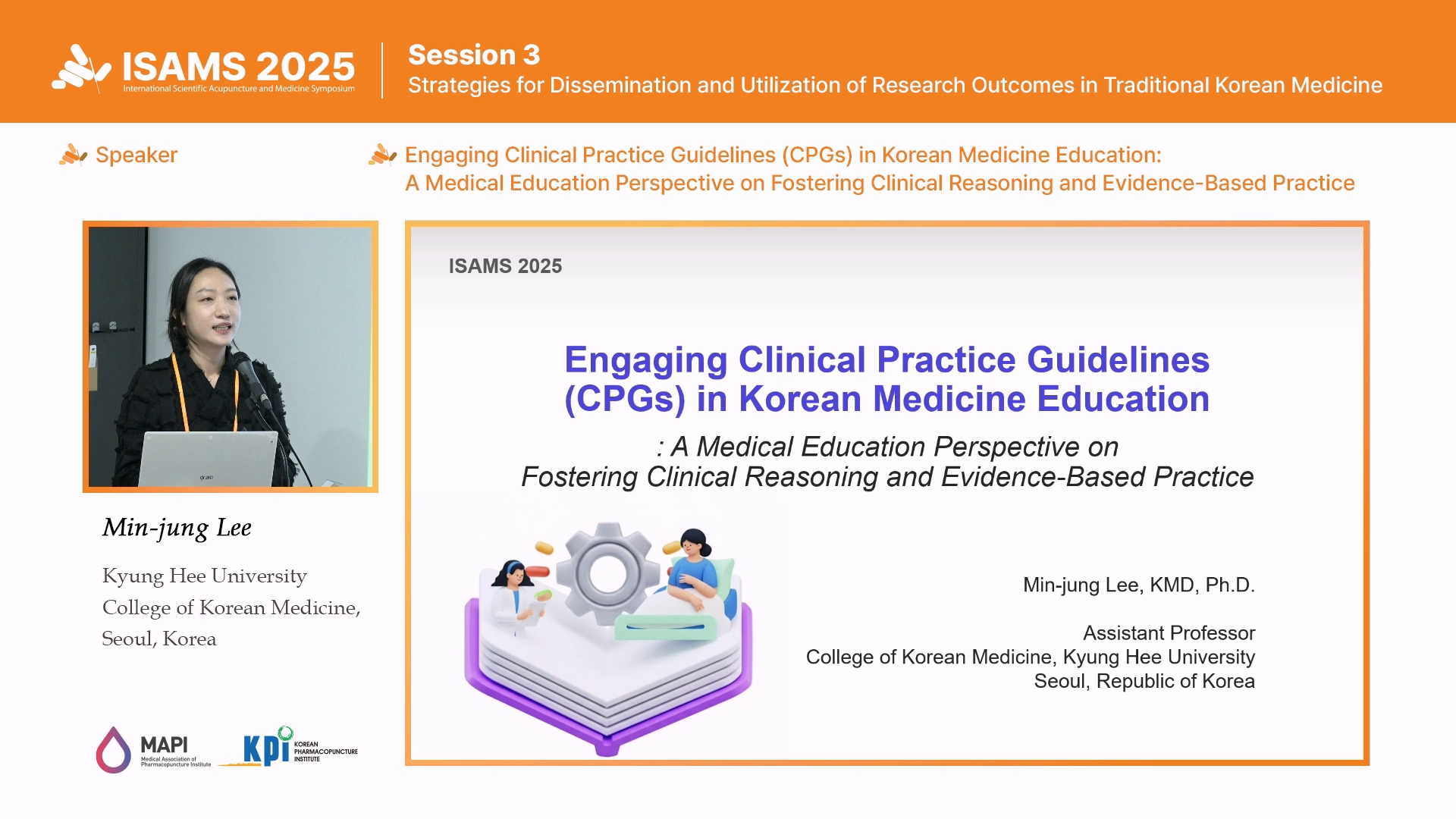
강의소개
Background: Clinical Practice Guidelines (CPGs) are essential tools for promoting evidence-based practice and structured
clinical reasoning in Korean medicine. Despite their growing availability, engaging students and faculty with CPGs in
educational settings remains limited and fragmented. Questions remain about how learners and educators perceive CPGs
and how meaningful engagement with these guidelines can be fostered in Korean medicine education.
Objectives: This qualitative study explores faculty perspectives on CPG engagement in Korean medicine education to identify
current practices, barriers, and strategies for effective educational integration. Specifically, we examined: (1) How do faculty
members view the educational use of CPGs? and (2) What strategies can enhance CPG engagement and improve Korean
medical education.
Methods: Structured written interviews were conducted with 20 faculty members from 11 Korean medicine institutions
nationwide, representing clinical medicine (n=14), basic medicine (n=4), and medical education (n=5) expertise. Interviews
explored faculty perspectives on CPG-based education, including current practices, expectations, perceived barriers, and
strategies for integration. Data were analyzed using thematic analysis following a six-phase framework, facilitated by ATLAS.ti
25. A complementary nationwide survey of students assessing their CPG understanding, learning experiences, and perceived
utility is currently in progress.
Results: Faculty emphasized the need for strengthening evidence-based medicine foundations as a prerequisite for meaningful
CPG engagement. They identified fragmented CPG exposure during undergraduate education as a major barrier and
advocated for more interactive pedagogies such as case-based learning and team-based learning. Educators highlighted the
importance of shifting from passive reference use to active, application-oriented learning approaches. Current CPG limitations
were also noted, including weak connectivity between diagnostic and treatment components, low usability in educationalcontexts, lack of contextual adaptation, and insufficient educational support tools.
Conclusion: Faculty perspectives reveal that developing critical thinking skills and CPG literacy is key to transforming CPGs
from static references into active learning resources. Dual innovation is essential, requiring both enhanced CPG quality through
improved connectivity, user-centered design, and AI adoption, and strengthened educational systems through evidence
based medicine foundations, faculty engagement, and institutional alignment. Integration with forthcoming student survey data
will provide comprehensive insights for cultivating learners who can critically and effectively engage with CPGs within clinical
reasoning in Korean medicine.
강사소개
Current Position
Ph.D. Candidate, Department of Human Systems Medicine, Seoul National University, Korea
Ph.D. in Medical Education, Seoul National University (Expected Feb 2025)
M.M. in Medical Education, Seoul National University (Aug 2022)
B.M. in Korean Medicine, Kyung Hee University (Feb 2019)