온라인강의
강사명Sung-Joo Park
강의시간34분
강의개설일2025-12-10
강의소개
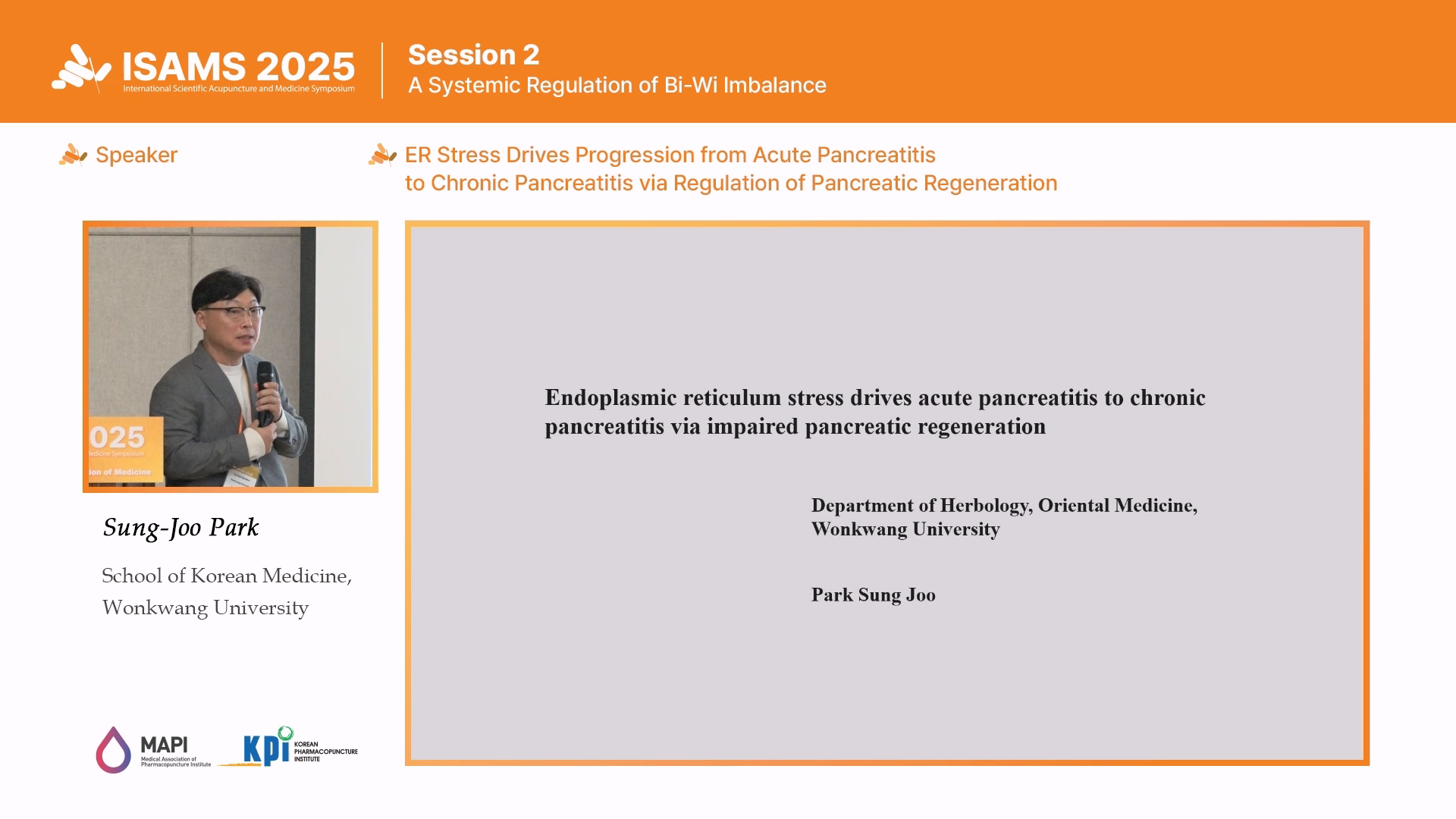
Objective: Endoplasmic reticulum (ER) stress is associated with alcoholic pancreatitis, but its role in pancreatic regeneration
and the progression from acute pancreatitis (AP) to chronic pancreatitis (CP) remains unclear. This study investigates the
influence of ER stress on pancreatic regeneration and its contribution to the progression from AP to CP. Design We explored
the effects of ER stress on pancreatic regeneration and the AP-to-CP progression using alcohol exposure and the administration
of ER stress inducer (tunicamycin), or inhibitors (4-PBAand TUDCA). We analyzed ER stress, inflammation, fibrosis, proliferation,
and regeneration. Additionally, ER stress was studied in interleukin (IL)-10 knock out (KO) mice, and macrophages/neutrophils
depleted models. the potential therapeutic effects of (-)-Catechin 7-O-b-D-xylopyranoside (CX) were also evaluated.
Results: Chronic and binge alcohol consumption prolonged ER stress and unfolded protein responses (UPR) and
delayed pancreatic regeneration compared to cerulein-induced pancreatitis. Distinct ER stress and UPR patterns were
observed in M1 and M2 macrophages at early or late regenerative stage, with macrophages depletion delaying both
ER stress resolution and regeneration. IL-10 KO mice showed persistent ER stress and impaired regeneration, indicating
the role of IL-10 from M2-like macrophages in these processes. Sustained ER stress impaired pancreatic regeneration,
contributing to AP-to-CP progression. Alcohol and tunicamycin or low dose cerulein (10 mg/kg) with tunicamycin
induced pancreatitis, while ER stress inhibition prevented alcohol and ethyl palmitate-induced pancreatitis. We further
discovered that CX administration reduced ER stress, enhanced regeneration, and prevented AP-to-CP progression.
Conclusion: ER stress plays a key role in regulating pancreatic regeneration and contributes to the progression
from AP to CP. Additionally, CX may offer therapeutic potential by modulating ER stress and enhancing pancreatic
regeneration, suggesting a novel approach for pancreatitis
강사소개
Education
1989–1995 College of Korean Medicine, Wonkwang University
1995–1997 M.S. in Medicine, College of Medicine, Wonkwang University
1999–2004 Ph.D. in Immunology, Osaka University Graduate School of Medicine, Japan
(Supervisor: Professor Toshio Hirano)
Professional Experience
2003–2004 Laboratory of Allergy and Immunology, RIKEN Research Center (Director: Professor Toshio Hirano)
2006–Present Professor, College of Korean Medicine, Wonkwang University
2009–Present Editorial Board Member, Korean Society of Pharmacognosy
2012–2014 Expert Committee Member, National Research Foundation of Korea (NRF)
2014–2015.02 Chair, Pre-medical Course, College of Korean Medicine, Wonkwang University; Director, Graduate
School, Wonkwang University
2014–2016.08 Senior Expert Committee Member, NRF
2018–2020 Committee Member, National Research Headquarters, NRF
2020–2021 Expert Committee Member, Korea Health Industry Development Institute (KHIDI)
2022–2023.01 Visiting Professor, Faculty of Medicine, University of Toronto, Canada
2025.01–Present President, Korean Society of Pharmacognosy