온라인강의
강사명Kangdong Liu
강의시간28분
강의개설일2025-12-10
강의소개
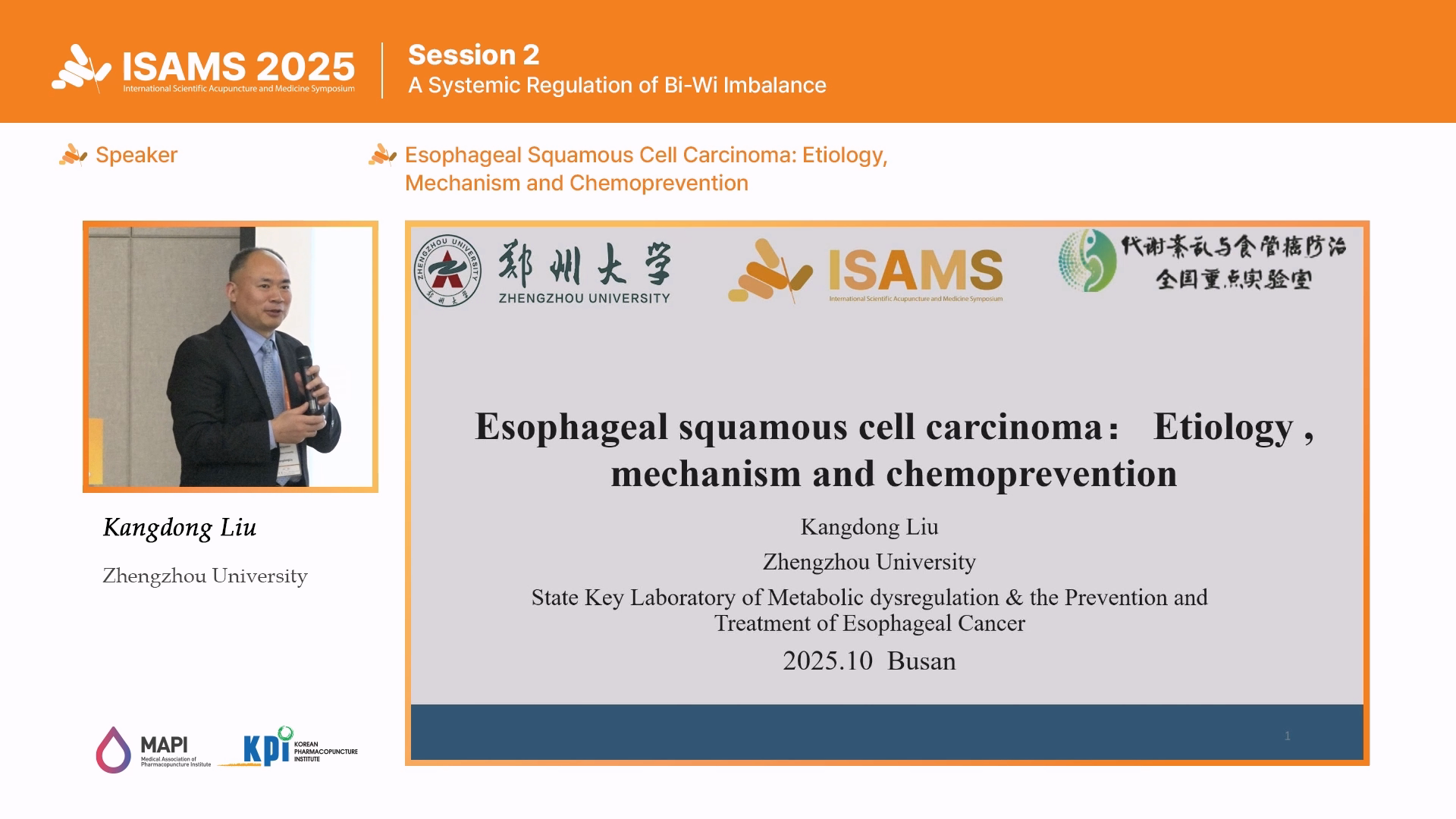
Esophageal cancer represents a global health concern, with an annual incidence of over 600,000 newly diagnosed
cases, accounting for over 3% of all cancer cases. Esophageal squamous cell carcinoma (ESCC) is mainly distributed
in East Asia and is the major type of esophageal cancer occurred in China. However, the 5-year survival rate for ESCC
is less than 20% due to recurrence, acquired drug resistance, and the lack of actional targets. Therefore, understand
the etiology and pathogenesis of ESCC and screen chemopreventive drugs are urgently needed to improve the survival
rate of ESCC patients. Exposure to harmful external stimuli, such as hot foods, chemicals, and others often results in
cellular stress responses, and contributes to cancer. Under the 42℃ and 4NQO stimulus, p38/ERK signaling pathway
was activated during ESCC progression. Long-chain-fatty-acid--CoA ligase 4 (ACSL4), which is a fatty acid metabolic
enzyme, can be phosphorylated by p38, resulting in increased production of myristoyl-CoA, then promotes Src
myristoylation and activates ERK. Epigenetic regulation is accomplished through the concerted effort of histone writers,
readers, and erasers. Alterations in epigenetic modulators are critical to cancer development and prognosis. BRD4,
as a “chromatin reader” protein, its interaction with TP73 facilitated the binding of BRD4 complex to the promoter
region of RCC2, and subsequently modulated RCC2 transcription. Genetic or pharmacological inhibition of BRD4
suppressed ESCC cell proliferation. Chemoprevention is a promising strategy to prevent the recurrence of cancer,
and screening the library of drugs already approved by the FDA to discover drugs for this purpose may be an effective
shortcut. Indomethacin as an anti-inflammatory drug, inhibits patient-derived xenograft tumor growth and recurrence
by targeting integrin αvβ3. And Arbidol as a broad-spectrum antiviral compound, inhibits ESCC growth through
suppressing ataxia telangiectasia and Rad3-related protein kinase.
강사소개
2019/ Director, Basic Research Center for Medical Sciences, Zhengzhou University
2014/ Professor, Executive Director, China-US(Henan) Hormel Cancer Institute
2014/ Professor, School of Basic Medical Sciences, Zhengzhou University
2015/ Professor, Academy of Medical Sciences, Zhengzhou University
2011/2013 Associate professor, School of Basic Medical Sciences, Zhengzhou University
2010/2011 Senior research assistant, Korea Research Institute of Bioscience and Biotechnology
2008/2010 Visiting scholar, The Hormel Institute, University of Minnesota
2006/2008 Lecturer, School of Basic Medical Sciences, Zhengzhou University