온라인강의
강사명Chien-Chen Huang
강의시간24분
강의개설일2025-12-10
강의소개
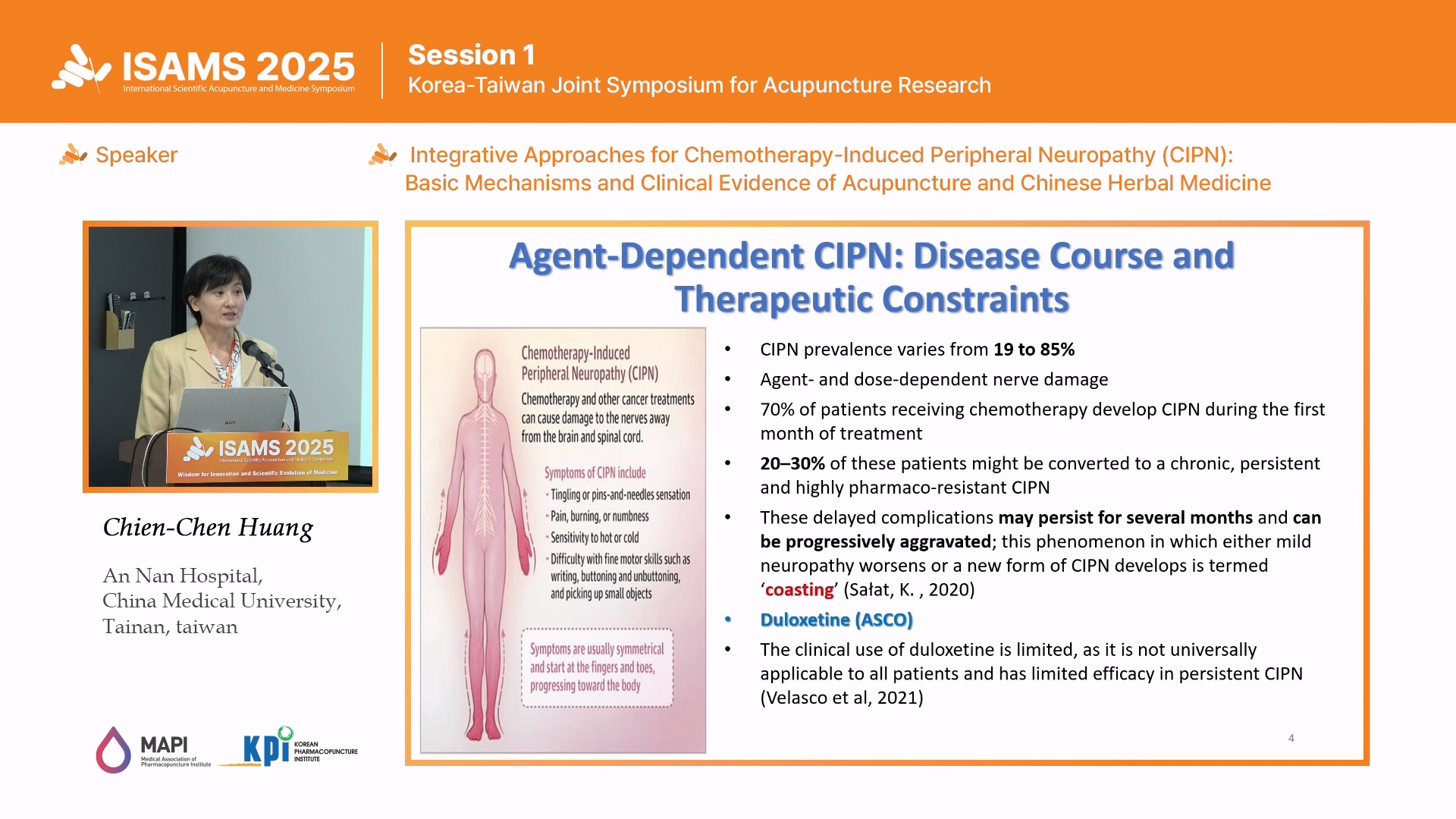
Objective: Chemotherapy-induced peripheral neuropathy (CIPN) is a frequent, debilitating toxicity of neurotoxic chemotherapy
that causes persistent pain and sensory loss. Pharmacologic options (e.g., duloxetine) provide only modest relief, underscoring
the need for new therapies. We investigated three integrative interventions—acupuncture, paeonol, and topical menthol—
examining mechanisms and clinical efficacy for CIPN.
Methods: We performed preclinical and clinical studies. Clinical efficacy of acupuncture was evaluated in a randomized, sham
controlled trial in taxane-treated breast cancer patients (n=20) receiving 15 sessions over 9 weeks. Outcomes included Semmes
Weinstein monofilament (SWM) thresholds and the Brief Pain Inventory–Short Form (BPI-SF). Mechanistic studies tested electroacupuncture
(EA) and paeonol in paclitaxel-induced CIPN mouse models. A pilot study assessed a topical menthol glove for tactile sensation.
Results: Acupuncture: Compared with sham, manual acupuncture significantly reduced pain severity (BPI-SF) and improved SWM tactile
thresholds in hands and feet. In mice, 10 days of EA (two 5-day courses separated by a 2-day washout) attenuated paclitaxel-induced
mechanical allodynia and suppressed spinal cord TNF-α and the apoptosis marker Bax. Paeonol: Oral paeonol reversed mechanical
and thermal allodynia in paclitaxel-treated mice; its effect was absent in adiponectin-knockout mice. Paeonol increased circulating
adiponectin and upregulated p-AMPK in spinal cord and dorsal root ganglia, indicating activation of the adiponectin/AMPK pathway.
Topical menthol: In a pilot study, menthol glove use improved tactile sensation, with benefits persisting up to one week after treatment.
Conclusion: Across complementary preclinical and clinical investigations, acupuncture, paeonol, and topical menthol showed
promise for alleviating CIPN. These integrative approaches reveal translatable neuroimmune and metabolic mechanisms and
warrant confirmation in larger, definitive randomized trials.
강사소개
PDr. Chien-Chen Huang is Director of the Department of Chinese Medicine at
An Nan Hospital, China Medical University, and Assistant Professor at the School of Post
Baccalaureate Chinese Medicine, China Medical University, Taiwan. She holds doctoral degrees in Chinese Medicine
(China Medical University) and master degrees in Clinical Pharmacy (National Cheng Kung University), as well as both
bachelor’s degrees in Pharmacy (National Taiwan University) and Chinese Medicine.
With over 15 years of clinical experience, Dr. Huang specializes in integrative approaches combining Traditional
Chinese Medicine (TCM) and Western medicine, particularly in integrative oncology, neurology, and supportive care.
She has been recognized as the Outstanding Clinical Teacher at An Nan Hospital in 2020.
Dr. Huang’s research focuses on acupuncture analgesia, safety in acupuncture practice, and the role of TCM in
cancer and chemotherapy-related complications.